Sunday, November 4, 2012

When Memory Dies


When Memory Dies
by A. Sivanandan
Published in 1997
Published by Arcadia Books
ISBN: 1-905147-59-7

A. Sivanandan, a Sri Lankan Tamil who left his native country for Great Britain in 1958, composed this novel about three generations of a Sri Lankan family who witness their country's descent into ethnic strife and the beginnings of civil war in the mid-20th century.

The narrative is divided into three sections, one for each generation. In the first section, Sahadevan, an educated Tamil, describes the trade union politics of the 1920s and 1930s through his friendships and family ties with those people who are in the midst of events. In the middle section, his son Rajan lives through the first years of independence. The entire novel is, in fact, narrated from Rajan's point of view, although he vanishes from the scene when he moves to Great Britain and disappears. The third generation is represented by Vijay, who, through some deft genealogical slight-of-hand on the author's part, continues the same family despite actually being Sinhala. He gets to witness the full-blown culmination of the disintegration of the social order that had so troubled his father.

What we have here, and what overshadows the book's actual narrative, is a political and social history of Sri Lanka from the 1920s to the early 1980s, from trade unions agitating against British rule early on, to the early years to Ceylon self-government, to the total breakdown of the country along communal lines in the late 1970s. Actual individual characters seem unimportant by comparison. Oh, there are plenty of characters about, but they all seem expendable. When something truly horrible happens (and many, many horrible things happen over the course of this book), you're warned of it several pages in advance by the shift in mood.

So I was never really able to get emotionally invested in this book. I found it a valuable read chiefly because it was educational. My wife and I are planning to visit Sri Lanka over next Chinese New Year, and when visiting a new, unfamiliar country, acquainting oneself with the basics of its culture and history are necessary to avoid being a bumbling, idiot foreigner. On one hand, the politics discussed in the book are now 30 years out of date. But on the other hand, they deal with the origins of the very same civil war which only ended in 2009, and remains the single defining event in the nation's recent history. The narrative itself may have left me cold, but When Memory Dies had true value for me for giving me a contextual framework upon which I can hang new bits of information about this nation of Sri Lanka.

Last month I wrote of Cory Doctorow's Little Brother that I found the novel weakest when characters ranted at each other about politics. By any objective measure, When Memory Dies is a hundred times worse in that regard, and the density of political ranting increases as the novel goes on, as characters shout cliched lines at each other. (I found it downright funny when, on page 360 of my edition, a character who appears nowhere else in the narrative pipes up to say of the Prime Minister, "Boy, that guy likes to play around with democracy, doesn't he?")

I actually didn't mind this so much, probably because it was far removed from my everyday experience -- hearing complaints about the dictatorial ambitions of Prime Minster Ranasinghe Premadasa was new to me, so my brain was able to contextualize it as data concerning political history. That said, by bringing this up at all I believe I have become both the first and the last person ever to draw a comparison between A. Sivanandan's When Memory Dies and Cory Doctorow's Little Brother.

Tuesday, October 30, 2012

An Important Question Concerning the American Presidency

Like many other Americans, I have spent the past few weeks deeply concerned about American politics and the American presidency. And there is one man I have been thinking about in particular. This is a man who won the White House following a tumultuous campaign, but now finds himself plagued with questions about his record.

I am, of course, talking about William Henry Harrison.

Harrison is not one of the most well-remembered figures in American history. If people remember him at all, it's as the President who died after just one month in office. Very few people look at Mount Rushmore and ask, 'Where's Harrison?" It's extremely uncommon for tourists in Washington, DC to ask for directions to the Harrison Memorial.

However, Harrison does apparently hold one distinction. It seems that he was the first sitting head of state, anywhere in the world, to be photographed. He sat for a photographic portrait on his Inauguration Day, March 4, 1841.

Photography was a cutting-edge technology in 1841. Primitive photographs had existed since the 1820s, but it was only in 1838-39 that the process was improved to the point that a person could sit for a photographic portrait. Photos exist of Harrison's predecessors John Quincy Adams, Andrew Jackson, and Martin Van Buren -- but as old men who were no longer President. Other heads of state would be photographed in the 1840s -- here's Queen Victoria in 1844, here's King Louis Philippe in 1842 -- but none before Harrison in 1841.

So the question which vexes me is, do we modern-day people have a copy of this photo or not?

Wikipedia claims we do. Wikipedia says, The original daguerreotype, made in Washington on his Inauguration Day, has been lost—although at least one early photographic copy exists in the archives of the Metropolitan Museum of Art. The lead image on this article is a digital version of the MMoA photograph.

I think the loss of the original would be mitigated if there are high-quality copies available. I'm only going to see the thing on computer screens, anyway.

Here's the photo:


This would appear to be a fairly good photo of William Henry Harrison. However, the information at the Metropolitan Museum of Art website says: Monroe Fabian of the National Portrait Gallery believes this daguereotype was taken from a portrait of Harrison painted by Albert Gallatin Hoit in the Spring of 1839. The painting is now in the Natl. Portrait Gallery in Washington, D. C., 4/22/69.

OK then, let's have a look at the Hoit portrait.


Taking a close look at each of these pictures, here are my observations:

1. These appear to be the same representation of Harrison, in slightly different media. They were clearly not created independently of each other. Either the photograph is a photo of the painting, or the painting was based on the photograph.

2. So which came first? If I had only these two pictures to go by, and did not have any other information at my disposal, at first glance I'd say the photograph was first, then the painting was created based on it, based on macro-level details that appear slightly different (like the eyes, and the flesh around the mouth).

3. After taking a closer look, I'm not so sure. The differences seem to lessen when you look closely, and the underlying texture when you take a very close look at the photograph might be canvas.

4. However, I am not an expert in optics or the visual arts, so don't put much stock in my uninformed impressions.

When you look at the historical record, it seems like the case is settled. The National Portrait Gallery dates the Hoit portrait to 1840. It even provides the following information:


Harrison's presidential candidacy inspired many requests from artists to paint him. One of the few that he honored came from Albert Gallatin Hoit, a New England portraitist with very good Whig connections. While painting Harrison, Hoit wrote home effusing over his subject's "striking head" and boasting, "I cannot fail." At least one contemporary critic thought he made good that boast, declaring the finished likeness "the best portrait" ever done of Harrison. 

So if the painting above was painted from a photograph after March 1841, this small vignette from American history has either been made up, or what we all think is the Hoit portrait isn't really the Hoit portrait. Neither of those is plausible. So the photo above was made from the painting, rather than the other way around.

I find it very unsatisfying that, if William Henry Harrison was the world's first head of state to be photographed, that we have no trace of that photograph any more. It makes me think that the record-keepers of the human race can't be trusted to look after our stuff. It makes me sad and causes me to hope that maybe some obscure German head of state (there were a lot of those in 1840) got his photo taken before March of 1841 and it still exists in good condition.

The folks at Wikipedia, meanwhile, are digging in their heels. Go to the top of Harrison's bio and they declare the photo in question to be a copy of the original daguerrotype made in 1841. There's a bit of lively discussion about this topic on the talk page, with one of the photo's defenders declaring, 'My understanding is that Hoit's portrait was based on the photo, not vice versa', without much to back up said 'understanding'. Hey, if you can convince me one way or the other, I'd be grateful.

ADDENDUM. After I wrote and published the above, I discovered this, purported to be an 1840 stereoscopic photo of Queen Victoria:


So maybe Victoria, not Harrison, was the first head of state to be photographed. OK, works for me!

Sunday, October 28, 2012

Little Brother

Little Brother
by Cory Doctorow
Published in 2007
Published by Tor
ISBN: 978-0-7653-1985-2

Eric Rabkins' final assigned book in his Coursera class Fantasy and Science Fiction: The Human Mind, Our Modern World is Cory Doctorow's Little Brother.

After a terrorist attack in San Francisco leaves thousands of people dead, the U.S. government acting through the Department of Homeland Security goes into overdrive to try and keep the city in proper running order. Local teenagers Marcus, Vanessa, Jolu and Darryl run afoul of the authorities in the immediate aftermath of the attack and are detained and interrogated. Days later, three of them are unceremoniously freed with orders not to tell anyone of what they've been through. Darryl, however, has vanished into the depths of the system.

Marcus and his tech-savvy friends proceed to rebel against the terrifying bureaucracy that has turned their city into a police state and vanished their friend Darryl. They sow a great deal of havoc and cause confusion a-plenty, but the more they do, the more paranoid the authorities get and the more innocent people are harmed by the system...

Little Brother was my first full Cory Doctorow novel, though I've read a couple of his short stories and I've followed his posts on BoingBoing for years. His writing zips right along, and there is never a dull moment (for the record, Little Brother is the first novel I've read to employ the definite article 'teh').

I am curious, though, as to whether some of Rabkins' students were taken aback by the ... immediacy of it. The previous novel in the course was Ursula K. Le Guin's The Left Hand of Darkness (which I elected not to re-read due to time constraints; I read it years ago). Despite taking place on a far-off planet, it has a great deal to say about the real world, and about human society. But it was published in the 1970s, and the planet Gethen is, as I said, far away from us.

Little Brother was published four years ago and takes place five minutes into the future. (Given the conspicuous lack of smartphones in the Little Brother universe, it makes the most sense to imagine it happening in an alternate-reality 2008.) It takes place in the USA, and the bad guys are the United States Department of Homeland Security.

To be honest, when I wrote this blog entry about people who shift uncomfortably in their seat when anything that remotely smells like politics is brought up, I was imagining the reaction of very staid people to Little Brother. But I'm firmly on the novel's side here. Little Brother would not be improved by moving the setting from San Francisco to the Planet Queebog and changing the DHS goons into, I dunno, agents of the Vorlaxian Empire. This story requires immediacy for its impact.

That said, I do have to say that one-sided political rants in fiction do tend to get my eyes rolling, and Little Brother is not entirely immune. I'm talking about the classroom discussions where Marcus and his teachers/classmates yell at each other about American politics (none of the scenes that took place outside the classroom bugged me).

Neil Gaiman, in his otherwise highly complimentary review, complained:

Cory's baddies are too bad, in some ways. There's a kid called Charles, who is an evil sneak, reprehensible in every way, who also holds political views that are at odds with our hero's, making us cheer Marcus when he starts quoting from the Constitution to defeat evil Charles...and Charles felt like a wet straw man. When things get ideological, I wanted Marcus to have at least one decent argument with someone who disagreed with him but at least seemed to have a point of view.

I agree with him. And now, weirdly enough, I have written about two consecutive books on this site that were shortlisted for the Hugo Award but didn't win, and each time I quoted from a review written by the author whose novel did win that year. I don't know how I managed that.

Friday, October 12, 2012

Why Obama Will Win

I'm sorry, but for the past week every liberal pundit in America has been wringing hands and freaking out about Mitt Romney gaining in the polls at Barack Obama's expense. This is vintage Democratic panicking, just as we remember from the first half of the last decade. It's unseemly and does no one any good, except Republicans.

It's totally unnecessary, says I (creating the world with my mind) and here's why. I live in Taiwan. Taiwan's been a participatory democracy since 1996, and its elections are held in the same years as American Presidential elections.

In years when the KMT wins in Taiwan, the Democrats win in the USA. (1996, 2008)

In years when the DPP wins in Taiwan, the Republicans win in the USA. (2000, 2004)

KMT president Ma Ying-jeou won this year. Therefore, Barack Obama will win the American election.

My mind is made up. Please do not attempt to change it with your primitive superstition known as 'statistics' and magical mantras like 'ridiculously small sample size' and 'no causal relationship whatsoever'.

Thursday, October 11, 2012

Let's Not Get Into Politics, Please


I saw this image on Facebook, and there was one comment that really rankled me. One person posted something like, 'Dr. Seuss just wrote fun stories for little kids. You shouldn't try to politicize them like that.'

Which is just silly, and slightly insulting to Dr. Seuss. Look at those altered titles again: none of them says anything like 'Republicans Are Bad!' or 'Don't vote for Senator Poopyhead!'

When that person complained about 'politicizing' Dr. Seuss, they meant explicitly pointing out that Dr. Seuss was writing about the real world. But can anyone read The Lorax or The Butter Battle Book and not see that Seuss was writing about the actual real world we live in?

That person's comment, if taken literally, would mean 'kid's authors should only write about pure fantasylands utterly disconnected from the issues of the real world, in works that mean nothing outside of themselves.' Which is nonsense.

So why do I feel empathy for people like that?

Because I don't think that's what the commenter really meant. I know what 'politics' means to many people. I know about the culture we're in.

I know that the culture is full of people who think that the way to discuss politics is to park their face two inches in front of their opponents and launch a tirade of nonsense. The loser is the person who flinches from the barrage of spittle. The winner might be vaguely aware that they violated some norm of civil behavior (or common sense), but they were justified, because the topic was important!

I know that, although intelligent, thoughtful people can certainly have strong disagreements on topics that they feel passionate about, there are also people out there who just like arguing, like to take the piss out of out of other people's positions just for the fun of it, sincerely believe that what they're doing is 'having an intellectual debate', and think the reason why some people don't like to play this game is that they 'don't like having their fixed beliefs challenged'.

I know that there's a whole cable-news industry out there that encourages this kind of behavior.

I have sympathy for people who don't want to participate.

So I completely understand people who get a weary look on their faces and retreat out of the conversation when the topic turns even vaguely political. Even when it's a false alarm.

It's a shame. These are people who are being discouraged from talking about serious issues in the real world. And I can't blame them. It's not their fault. Our culture is failing them. 

Monday, October 8, 2012

A Dance with Dragons

A Dance with Dragons
by George R. R. Martin
Published in 2011
Published by Bantam Books
ISBN: 978-0-553-84112-1

And so we come to the last book of A Song of Ice and Fire that George R. R. Martin has yet completed.

I'll put all comments under SPOILER SPACE, except for one wailed warning for those who might seek to pick up this book:

It resolves nothing! It resolves NOTHING! Nooooo-thiiiiing!!!


A Dance with Dragons spends its first two-thirds catching up with the characters who were left out of A Feast for Crows: Tyrion, Jon Snow, Daenerys, and Bran (who makes the most of very little time spent as viewpoint character).

I'll admit that I felt a bit impatient during bits of Tyrion's and Daenerys' early chapters, anxious to get to more plot-heavy parts. That proved to be a mistake -- later on I had to go to A Wiki of Ice and Fire to get all the Meereenese character straight.

It's not that Martin's writing ever gets boring -- it doesn't. I read the first half of A Dance of Dragons on a multi-day trip where my physical activity was curtailed by a leg injury, so I happily sat reading in the passenger seat of our rented car while my traveling companions would go off and take photos. The book served its purpose.

Rather, the problem is that Martin's writing style makes the reader perpetually think something world-changingly awesome is just around the corner, so however engaging page n might be, page (n + 100) is going to be even more engrossing, so the reader can't help reading quickly to get to the good parts, and by 'the reader' I mean me. What makes things worse is that we all remember the second half of A Storm of Swords, when something world-changing really did happen every couple dozen pages. But realistically speaking, we're not likely to return to that fast pace until the final book.

So we're left with a book that builds and builds and adds complexity to an already complex story, and then it stops and we have to wait for book 6. Now I feel some sympathy towards all those fans who pestered Martin to hurry up while he was very slowly writing book 5.

 Martin knows how to tease us, particularly in one Bran-viewpoint chapter when he added fuel to the fire of the long-lasting fan debate about Jon Snow's true parentage. Bran's using the Godswood network to see into the past, and he inadvertently spies on a much younger version of his father praying, 'let them grow up close as brothers, with only love between them', presumably referring to Baby Robb and Baby Jon, and the more suspicious among Martin's readers think, so they're 'close as brothers', huh? Doesn't that imply they're not brothers?

Then Bran sees a girl who looks like Arya playing at swords with a younger brother, in a generation where Old Nan is already old, and the obvious conclusion is that the girl is Bran's dead aunt Lyanna and the boy is... somebody. (Benjen?) Readers who enjoy speculating about Jon Snow's parentage perk their ears up whenever the name Lyanna Stark is mentioned, and her mention here is going to drive them crazy.

So, about that Jon Snow. If George R. R. Martin genuinely believed his readers would finish the novel believing that Jon was 100% dead forever and ever, then he drastically misjudged the expectations he'd built up. The question is what's going to happen to Jon now that he is a corpse. Many readers assume Melisandre is going to reanimate him (although I must point out that it's never been shown that Melisandre has the power to reanimate the dead -- everyone just assumes she can, since Thoros of Myr can and he's also a Red Priest). But from the very beginning of A Dance with Dragons, we readers are prepared for the possibility that if Jon's human body dies, he can survive within the direwolf Ghost. I suspect the latter is far more likely, although what would be really creepy (and entirely possible) is for Jon's true spirit to survive in Ghost's body while Melisandre reanimates his human form into a soulless abomination. I think I may bet my money on that.

Many readers moaned, after finishing Book 5, that there is no way Martin can finish this story satisfactorily in just two more books. In contrast, Jo Walton of Tor.com writes in her non-spoiler review:

And there’s evidence that the series is heading towards some kind of actual closure — I was worried that things were opening out and out and nothing was coming back together, but I can see hints of the shape of how it will be coming together. Martin’s been calling this book “Kong” and talking about it as a monkey, but I was afraid it was more of an octopus squirming out of his control — but I see signs of tentacles being nailed firmly down.

Both Walton's non-spoiler and her spoiler review is also worth reading, and not just because of the irony that at the time she wrote them, no one knew that it would be her own novel that would beat out A Dance with Dragons for the Hugo Award.

The main complicating factor that readers moan about is the addition to the political mix of one Aegon Targaryen, rightful heir to the throne of Westeros. Let me repeat that: assuming his ancestry is what he claims, Aegon is now the Targaryen pretender. Not Daenerys. For Daenerys to be the rightful heir, she is going to have to wait for Aegon to die without procreating. Now readers are complaining that the political situation has been complicated needlessly, and there's no way Martin can bring the story to a satisfying conclusion in just two more books now, oh no oh no oh no.

I, however, suspect Aegon's going to die in a spectacular way that will move the plot towards its conclusion. (This is known in Westerosi political circles as 'pulling a Renly'.) Or I could be wrong and Aegon might live, but I'm pretty sure Martin's got a plan for him that will bring about this big fat story's endgame. As much as I like the journey, I'm hoping that sometime over the next decade, an endgame is what we readers get.

Saturday, October 6, 2012

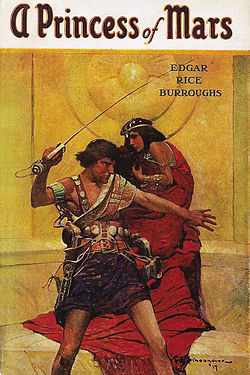
A Princess of Mars

A Princess of Mars
by Edgar Rice Burroughs
Serialized in 1912
Published in novel form in 1917

In his Coursera class Fantasy and Science Fiction: The Human Mind, Our Modern World, Professor Eric Rabkin has assigned us one of the all-time famous examples of pulp science fiction.

Rather than give a traditional plot summary of Edgar Rice Burroughs' 1917 kickoff to the John Carter of Mars series, A Princess of Mars, I thought I would just link to the trailer for the 2012 movie John Carter:

The movie may have gone down in history as one of the great money-losers of all time, but it was based on classic old-timey-science-fiction material:


That's what the book is like. Just like that. It doesn't matter that I hear the movie mixes in elements of later books in the series. The book is just like that trailer.

Except in Edgar Rice Burroughs' original world, the humans (apart from John Carter) have red skin. Also, everyone's totally naked apart from armor and decorations. Burroughs makes that quite clear in the book.

The original A Princess of Mars occupies an interesting place in pop culture history. It was a boy's adventure story written when the modern genres of science fiction and fantasy hadn't really come into being in their modern forms yet. Oh, they both existed embryonically -- H. G. Wells wrote examples of the former, L. Frank Baum's Oz books are an example of the latter -- but the genres weren't fully established.

A Princess of Mars manages to straddle early forms of both genres, not that it would have meant much in 1912. John Carter transports himself to Mars via pure fantasy. He manages to teleport his spirit there, leaving his physical body behind on Earth, but once he's on Mars he's somehow there in both body and spirit. But Burroughs is thinking about things like a modern science fiction writer, too. John Carter is only faster and stronger than any of the locals because he's used to a much higher gravity, and the early scenes of Carter bumbling about in a low-gravity environment are pretty indistinguishable from how a science fiction writer would write them today. And Mars has a breathable atmosphere only because of sophisticated geoengineering by the Martians.

About those Martians. You see from the trailer I linked to that there are both human-looking Martians and the big green guys with tusks and four arms? They're both natives of Mars, or as they call it, Barsoom. They both hatch from eggs. The humans -- Red Men -- live in cities and have advanced technology, although they're still Swashbuckling Fantasy World Humans rather than proper Europeans of the year 1912. The aliens -- Green Men, who look in that trailer pretty much like they're described in the book -- are noble savages. They have a violent, barbaric culture and aren't used to the idea of living in cities. But they're not a single undifferentiated mass. There are good Green Men and evil Green Men.

And then there's John Carter, who despite being an alien manages to rise improbably high in Barsoomian society, because he can jump really high and punch really hard and he has the grit that comes of being a strapping young Anglo-Saxon.

This is a really old trope. TV Tropes calls it Mighty Whitey. It's also been referred to as 'What These People Need Is a Honky'. Even nowadays, remnants of this trope keep popping up in science fiction and fantasy. Avatar is the most infamous example, but also see Star Trek: The Next Generation, where Jean-Luc Picard keeps injecting himself into Klingon politics at the highest levels. (Imagine the reverse situation, if there was a Klingon captain who regularly smoothed out domestic policy disputes for the President of the Federation. That would be strange.) Or Babylon 5, where the greatest leader in the history of the Minbari people was Valen, an Earthman who came to them a thousand years ago and radically reorganized their society.

That said, John Carter is still only the second most blatant Mighty Whitey that Edgar Rice Burroughs created.

Friday, October 5, 2012

The Island of Doctor Moreau

The Island of Doctor Moreau
By H. G. Wells
Published in 1896

H. G. Wells' The Island of Doctor Moreau is an 1890s novel full of things that will make you feel very uncomfortable, both physically and intellectually.

It's a typically 19th-century first-person account, from the point of view of an innocent European who finds himself stranded on a remote tropical island, with the infamous Dr. Moreau, his assistant Montgomery, and a large number of things which are animal-like humans, or human-like animals -- it's difficult to tell which at first.

The island is the venue for Moreau's attempts to make various species of animal more humanoid, both in terms of their physical shape and their mental abilities, for no practical purpose that Moreau is able to satisfactorily explain, other than 'for SCIENCE!'.  The book was written long before science fiction writers knew about DNA, so Moreau does his thing entirely through old-fashioned 19th-century surgery and grafting, which is every bit as horrifying as you can imagine.

The most advanced work Moreau is able to do before the plot shuts down his scientific research for good yields creatures which look almost, but not quite, look human, and are capable of speech but don't have anywhere near the brainpower to displace human beings from the jealously guarded summit of the intellectual pyramid. (Nine decades later came David Brin's Uplift series which also features animals with improved brainpower, and his universe includes chimpanzee professors. It seems human science fiction writers had grown less insecure about the mental abilities of uplifted animals by then.)

The Island of Doctor Moreau is a product of the late 19th century, and of course Wells unconsciously writes bits that rankle us today. One of Moreau's early subjects was a gorilla, which Moreau transformed into 'a fair specimen of the negroid type', and I can't help but assume Wells' enlightened 1890s British readers were supposed to think of course it would be easier to transform a gorilla into a human 'of the negroid type' than into a more European-looking specimen (fewer steps, after all).

That said, it's not necessarily a racist work when looked at as a whole, and if it's taken as a commentary on the dark side of colonialism it can be seen as almost progressive -- if you ignore the fact that the colonized 'people' in this story are literal wild animals that the White Man is trying to make more human.

The Invisible Man

The Invisible Man
by H. G. Wells
Published in 1897

Eric Rabkin's class Fantasy and Science Fiction: The Human Mind, The Modern World includes two H. G. Wells books. The Invisible Man occupies an odd place in our culture. It's a very well-known trope, but not a very well-known story. Everybody with even a passing familiarity with the science fiction genre has a mental image of the fully bandaged Invisible Man, unwinding his layers of gauze to reveal... nothing. But relatively few people know what the actual plot of the original novel is, or even if the Invisible Man is a good guy or a bad guy in this, his first incarnation.

As H. G. Wells writes it, the Invisible Man (who is named Griffin) is a bad guy, a sociopath who shows no remorse for his actions, even though he injures (and kills) many innocent people and is indirectly responsible for his father's death.

But he is a supervillain with a poorly chosen superpower. A theme of Wells' novel is that invisibility, if one can't cease to be invisible, is exceptionally overrated. Griffin is incapable of passing for a normal person, and the disadvantages of being invisible greatly outweigh the advantages. He can't walk down a city street without being inadvertently injured by people who can't see him. He can't carry anything without giving away his presence and attracting attention to himself. He is good at two things, sneaking up on people and getting away afterwards, but this doesn't outweigh the tremendous disadvantages that his 'power' carries.

And yet Griffin thinks he can set himself up as a master supervillain and tries to institute a 'Reign of Terror'. He is defeated, in the end, by ordinary English villagers (speaking phonetically-written English local dialect) who coordinate and work together to bring him down.

This book, the original version of the 'Invisible Man' trope, contains some fun little details that didn't always become well-known. For example, Griffin's is able to turn himself invisible because he's an albino. Otherwise, the invisibility process wouldn't have worked on the pigmentation in his skin, eyes, and hair, making him semi-visible. An early experiment of his was on a white cat with green eyes. He successfully turned the cat invisible -- except for the green eyes.

Wednesday, September 26, 2012

My Day at Yuemeikeng

I haven't blogged much since, oh, August 30. I'm not dead, or in a coma, or feeling out of sorts; it's more the fact that I've been busier-than-normal with work lately as well as the fact that my urge to blog comes and goes.

But now that my wife has posted her story of what happened to me last September 9 -- aka The Closest I Ever Came to Being Seriously Injured -- I thought I would post my own version of the day's events. 

With our friend Emily visiting from Australia, that Sunday we thought we would return to the waterfall at Yuemeikeng, near Jiaoxi, Yilan County. Yuemeikeng's not very well-known -- tell a northern Taiwanese person you're going to see a waterfall near Jiaoxi and they're almost certain to assume you mean Wufengqi -- but it's gorgeous, as Jenna and I found out last year (see our pictures in the link).

Getting to Yuemeikeng means tracing a river upstream a ways. The water level was much higher than we remembered it, but this wasn't a huge problem as we were prepared to get wet. This isn't the kind of river where you can be swept away by the current. 

We reached a big, beautiful waterfall, where the water crashed down into a big, deep pool of water, a pool so deep we couldn't touch bottom despite our repeated attempts. We frolicked in the water for some time, enjoying the respite from the hot Taiwanese summer air.

But it wasn't Yuemeikeng proper -- the really spectacular waterfall was further upstream. We knew. We'd been there. Unfortunately, the steep trail that paralleled the waterfall we'd been frolicking at was not something that gave a sense of well-being. There were some hikers who were managing the climb without much difficulty, but they had professional-looking climbing equipment. We didn't. Jenna made it halfway up before declaring that she would fall if she tried to keep going. 

So our choice was to turn around and go back, or find another trail up. (Complicating our decision-making process was the fact that Jenna and I had done this hike before, but neither of us could precisely remember how we'd done it. I wasn't sure whether we'd taken a safer, pre-typhoon version of that scary path up, or a different trail.) We backtracked a bit and found another trail up, one which was steep but seemed doable. We took it up a ways (Jenna in the lead, me in the middle, Emily in the back), but our faith in its ability to convey us safely to level ground steadily waned as it got more overgrown, and we were finally on the verge of giving up and going back down. And then the ground under me slid, and I lost my footing.

Here's where my point of view diverges from the others. But memory's a funny thing. Immediately after the accident, I could remember everything, as I told Jenna and Emily. But with time, my actual memories of the fall seem to have receded, and now what I'm left with are memories of my remembering.

I can say this: as I was falling, and hitting branches and twigs on the way down, I didn't feel any physical pain and I didn't even feel scared. I felt indignant. I'd hiked lots of times before and this wasn't supposed to happen to me. We'd given up on that other steep trail because it was too dangerous and this wasn't supposed to happen to me. I was working the next day and I didn't want people to worry about me and this wasn't supposed to happen to me.

Then I was in the water. I was in the exact spot where we'd been happily frolicking just minutes before. I was wearing my backpack, which contained many things I didn't want to get wet, and my first priority was to get it out of the water. There was a river tracing team coming through, and a woman in the water with me who was trying to help me. But I didn't need her help, I just needed to get my backpack out of the water and then rejoin Jenna and Emily. I kept trying to shove the backpack up onto the dry rocks, but my body felt weak. And my brain was preoccupied with trying to convince the woman that I was okay and didn't need help. It wasn't until Emily scrambled down the hill and arrived on the scene that I realized I was bleeding profusely from somewhere on my head. I'd managed to rip a sizable tear in my scalp.  And that when I was helped out of the water, my left leg would not support my weight. My knee was cut open and my shin was a mess of cuts. 

The river tracing team was relieved to see someone was taking care of me (and therefore I was Not Their Problem), and stuck around to see Emily bandage my head and my knee with towels. When I stripped off my bloody shirt, there was a collective gasp from the river tracers at the ugly condition of my left shoulder and left side of my back -- a very nasty collection of bruises and scrapes. I must admit that, as someone who reflexively downplays his own injuries for fear of coming across as a malingering whiner, the river tracing crowd's unbidden gasp of horror at the appearance of my shoulder felt good somehow. Satisfying, in a weird way, like I was being paid a compliment. Ironically, those cuts and bruises turned out to be largely cosmetic injuries -- they looked ugly, but they healed quickly, and didn't give me any trouble.

Emily, who knew first aid, stayed with me to make sure I stayed conscious and to keep my brain active (for all anybody knew I might have suffered a concussion). Jenna, who speaks better Mandarin, went to get help. What followed was me, sitting on a rock for what seemed like a very long time, with Emily keeping an eye on me. I was antsy and uncomfortable (which I apparently managed to hide from Emily well enough), but I couldn't put weight on my left leg, so there was nothing I could do but wait for help. Emily didn't think I'd actually broken any bones, though, so there was that to comfort me.

Eventually a lone rescuer showed up, checked me over, and decided I was fit to be moved. He went back to report to his teammates. A couple of minutes later a couple of rescue guys showed up and announced they were going to get me up the hill and back to the main trail. They did this by tying a rope around me and then half pulling, half prodding me up the hill, often forcing me to put pressure on my bad leg, all the while shouting at me in Taiwanese. (It just had to be Taiwanese. I'm not a master of the Mandarin language but I generally have a good chance of understanding instructions shouted at me in it. Taiwanese, on the other hand, I am hopeless in.) 

I was in a really foul mood by the time they got me to the trail. Getting me up the hill was one of the most unpleasant experiences I have ever undergone. But then, it wasn't the rescuers' fault that I had managed to get myself hurt in an inaccessible place. And as for shouting at me in Taiwanese, well, I can't blame local guys for using the language they feel comfortable with.

Once on the real trail, they laid me on a stretcher and I didn't have to do anything. I get the distinct impression that I caused something of a social event, as there were far more people on the trail back to the ambulance than were necessary. We think it was a case of, 'Hey, a dumb foreigner got himself hurt in the woods near Jiaoxi, wanna come see?' Can’t blame them.

I'm very grateful to these rescuers who got me out of the gorge and into an ambulance. As I said, I managed to injure myself in a relatively inconvenient and inaccessible spot, and I was lucky it was in a place where a rescue squad could be quickly called together. (I can only imagine the situation if I had gotten hurt in the remote wilds of mountainous central Taiwan.) 


The ambulance took me to a hospital in Yilan, where I received very good care. They gave me a CAT scan and X-rays to confirm I hadn't broken any bones or suffered hidden internal injuries, and the doctor sewed up my scalp and my leg. I was released from the hospital late that evening, and Jenna helped me hobble to a nearby hotel for the night.

Two days later I was working a full schedule again, although rather slowed down and with a large bandage on my head.

I'm happy that I had my health insurance card with me in Jiaoxi. As a foreigner from the land of America, let me say that I am a huge fan of Taiwan's national health insurance system. The funny thing is, even after this experience and the multiple doctor's visits I've had to make, I suspect the Bureau of National Health Insurance has still made a profit from me overall, since I've been working and paying taxes in Taiwan since 2007 and I can think of only two insurance-covered doctor's visits I made before this most recent mishap. By thinking in these terms at all I'm grossly mishandling the very idea of insurance (after all, a person who needs more resources than they have paid into the system over their lifetime hasn’t crossed some sort of Lazy Bum Threshold) but I don't want anyone to read this and think that I'm a foreigner mooching off of hardworking Taiwanese taxpayers' dollars.

By the way, if anyone wants to comment on my blog by taking commentary from the American health insurance debate and inelegantly transposing it to a Taiwanese context, I will publish your comment after receipt of a $150 commenting fee (U.S. dollars).  Thank you for your understanding.

Items lost in the fall include:


  •      My wedding ring. I imagine a branch snagged it and ripped it off. As Jenna said, better I lose the ring than a finger.
  •      My glasses. This was not a huge loss, as I’d been somewhat mistreating this pair and I’d managed to damage the lenses. Still, it means I’m down to my backup pair, so I need to go glasses shopping in the near future.
  •      My cell phone, lost to water damage (it was in my backpack). This was no great loss. It was a crappy old Nokia that was cheap when I bought it 3 years ago. And my SIM card survived.
  •      My iPod Touch, also lost to water damage. It was fourth-generation, and I’d had it for about two years. I mourn its loss significantly more than the cell phone, but in the two years I had it I used it so much that I more than got my money’s worth. I still plan to take its plastic-and-metal corpse to the store where I bought it to see if it can be repaired.

The loss of the last two items are made up for by Emily's awesome generosity, who gifted me with a Samsung Galaxy S II that she wasn’t using. It’s the first Android-based device I’ve ever used, so I’ve been cheerfully learning my way around it. 

To sum up, I keep thinking about how amazingly lucky I was to survive the incident with relatively minor injuries. Yes, it's been two and a half weeks and I'm still limping along with a cane, but my situation would have been far worse if I'd hit a rock on the way down or had landed somewhere other than a pool of deep water.

But I survived, and with injuries that did not even require an overnight hospital stay. Make no mistake, I don't believe in deities that interfere in human events, but I did get very lucky. 

Friday, August 31, 2012

Dracula

Dracula
by Bram Stoker
Published in 1897

The third of my assigned readings from Professor Eric Rabkin's course Fantasy and Science Fiction: The Human Mind, the Modern World is Bram Stoker's novel Dracula. Stoker didn't invent the idea of vampires, but he codified the trope and most of our modern images of vampires are ultimately descended from Stoker's version of the vampire myth.

The story begins with English solicitor Jonathan Harker traveling to Transylvania to meet with the elderly nobleman Count Dracula to discuss property in London which Dracula wishes to purchase. Dracula turns out to be immaculately polite, the very model of old-timely European gentility, eager to learn more about England and English ways, and (as the reader no doubt expected), utterly, alarmingly creepy. In the end, Harker barely escapes from Dracula's castle alive, his wits shattered.

Meanwhile back in England, Dr. Seward operates a lunatic asylum next door to the property where Dracula is about to take up residence. He is in love with Lucy Westenra, a young lady who is nevertheless engaged and then married to one Arthur Holmwood. Lucy is also best friends with Jonathan Harker's fiancee Mina Murray. (Dracula takes place in a very small universe and coincidences abound.) Lucy becomes deathly ill (Dracula is slowly consuming her, as readers know but not Arthur or Dr. Seward), and Dr. Seward is forced to call upon his mentor from continental Europe, Van Helsing, who speaks fractured English but immediately diagnoses poor Lucy's problem.

There's also an American from Texas, Quincey Morris, who is an excellent example of what British people in the 1890s thought Texans sounded like. He rounds out the team of vampire hunters. Although the novel doesn't really have a clear paramount protagonist, Mina Murray is an early deconstruction of 'useless woman' tropes; when the men are reluctant to involve her because she's a fragile female, things take a turn for the worse; when she's given the same respect as other members of the team, they make progress in their chase against Dracula.

I was surprised at how many recognizable modern-day vampire tropes appeared in Dracula. I was expecting a reading experience more like Mary Shelley's Frankenstein. Most modern-day Frankenstein tropes did not emerge until long after Mary Shelley's lifetime, and even a reader who is aware that Frankenstein is the name of the scientist (not the monster) is usually surprised to learn that in Shelley's novel Frankenstein is not a crazy old man but an over-eager young medical student, and while the monster really is an eight-foot-tall abomination, he can speak quite fluently and is arguably the most eloquent character in the novel.

In contrast, the title character in Bram Stoker's Dracula is very close to his modern-day popular image. The main differences are that this Dracula can walk about outside while the sun is shining (he just can't access any of his special vampire powers) and while a wooden stake can indeed kill him, a steel spike will do just as well. Also, he has a big, intimidating mustache, which generally didn't survive adaptations to other media. Otherwise, the original version of the character is almost identical to his modern image, right down to his grasp of English (he is explicitly described as speaking impeccable English but with a very foreign intonation). The novel invented the idea that vampires can't cross running water, a limitation that makes no sense but does prove very useful to force the plot to keep on the track Stoker has in mind.

In the novel, Dracula has three sexy vampire wives who try to seduce Jonathan Harker and are eventually slain by Van Helsing prior to the final battle with Dracula himself. As Professor Rabkin touched upon in his lectures, before Stoker came along, vampires were seen primarily as female monsters, and Stoker is singe-handedly responsible for the fact that male vampires aren't necessarily perceived as gender-benders today.

As a final odd factoid, Dr Seward may be the earliest character in literature to keep a journal in audio recording form. For what it's worth.

Thursday, August 30, 2012

The World, Politics, and Me

Dear People of Politics, USA:

Democrats: Most of you are perfectly well aware that when Mitt Romney said 'Corporations are people', he did not mean 'a corporation is a kind of human being'.

Republicans: Most of you are perfectly well aware that when Barack Obama said 'You didn't build that', he did not mean 'Americans are incapable of doing anything constructive without Big Brother's help'.

Oh, you'll claim that you're sure he really meant it that way. Maybe you won't recant even under the threat of thumbscrews and waterboarding. You're too emotionally invested in making fun of The Other Side to admit that you're deliberately misunderstanding Big Ol' Stupidhead here. But you are. Deep down, you know you are.

That's because there is no way reality could admit the existence of the person you're making Big Ol' Stupidhead out to be. Even a plutocrat who wears a top hat and a monocle and uses employees as footstools knows that a corporation is not a kind of person. Even a tyrant who wants all people to work for the federal government knows that people can build things. These are not things that, deep down, people who have a functioning theory of mind believe Romney or Obama meant.

I do not say this lightly. It grates on me when some opinion-mongering person assumes they know what other people are thinking, like they never got the 'other people have their own minds' memo back in early childhood cognitive development. I'm well aware I'm treading perilously close to that ground. That's why I said 'most of you' rather than 'every last one of you'.

OK, now I'm a nerd at a sporting event pointing out that the taunts fans shout at the other side aren't literally true. Why did I bring this up?

I've got a very pragmatic view of politics. I don't gasp with horror when I see a politician say something that I'm pretty sure he knows perfectly well is untrue. I don't even become perplexed when I see a crowd applaud a statement that I suspect most of them don't really and truly believe.

But I am very naive in one way. I'm a little too attached to the actual world. If well-known politician Dumbpants McGee, who I don't like, gives an impromptu talk without a teleprompter and says something that can be hilariously misunderstood, I'll laugh along with everyone else. But every time Dumbpants McGee's stupid comment is repeated afterwards, I'm going to think, 'You do realize that wasn't really what he meant, right?' I might not say it out loud, but I'll think it.

Please, people of politics, be more understanding and tolerant of people like me. If we say, 'But Senator Dumbpants didn't mean to say that; it's clear if you look at the full context', maybe we're not secret supporters of Dumbpants McGee. Maybe, in fact, we hate him as much as you do. Maybe we're just clinging a little too tightly to the actual world.