Thursday, January 31, 2013

Boxer, Beetle

Boxer, Beetle
by Ned Beauman
Published in 2010
Published by Sceptre

Seth 'Sinner' Roach is a five-foot alcoholic gay Jewish boxer in 1930s London. He's a thug whose instinctive dislike of all things intellectual makes things difficult for Dr. Erskine, upper-class British entomologist and Hitler admirer. Erskine, who reflexively spouts anti-Semitic rhetoric and is in denial about his own homosexuality, is captivated by Sinner and wants to use him for his research into eugenics.

Many complications ensue, culminating in a grisly murder at Erskine's family estate.

The story of Sinner and Erskine is pieced together decades later in 21st century London by the book's narrator Kevin, a collector of Hitler memorabilia who suffers from a genetic disorder that causes him to smell like rotten fish all the time, no matter how assiduously he maintains his personal hygiene.

Ned Beauman plays with a lot of well-established cliches relating to the upper crust of British society in Boxer, Beetle, which in the end is a very well-done, weird and slightly surreal black comedy.

Boxer, Beetle was Beauman's first novel. Every so often I enjoy reading a novel that appears to have been written by an author who was attempting to insert as many bizarre things into a narrative as humanly possible and still have it make logical sense. I wouldn't want every bit of fiction I read to lay on so many discrete variations on life's weirdness, but a tour of the bizarre is quite refreshing once in a while.

You'd never guess, even from a detailed plot summary, that the book contains lengthy asides into the world of modern urban planning. As someone who quite enjoys a good organically grown bustling urban neighborhood, I found the description of a poorly designed postwar British planned community to be hilarious.

I came across Ned Beauman's first novel after coming across glowing reviews for his second novel, The Teleportation Accident.  And I bought it for my Kindle upon realizing that it was going for extremely cheap, whereas for The Teleportation Accident they were asking $16.00. I don't doubt for a moment that Amazon set its pricing precisely so that people in my exact situation would do exactly as I did. I cheerfully followed the script that corporate people created. And that's OK. I enjoyed the book that I got out of it.

Wednesday, January 30, 2013

American Front

American Front
by Harry Turtledove
Published in 1998
Published by Ballantine

The year is 1914 and the Great War has erupted. Over the next year and a half, the fighting rips North America to shreds.

But first, an explanation is in order.

American Front takes place in a universe that was inaugurated with Turtledove's 1997 novel How Few Remain. The premise is as follows. In 1862, the USA was decisively humiliated by the Confederacy on the battlefield and was forced to sign a peace treaty. The Confederate States of America is now recognized by all as a legitimate country. (Despite the tropes Turtledove has played with in other novels, this happens naturally, with neither time travelers nor aliens playing a role.)

How Few Remain opens in the year 1881, when relations between the USA and the CSA deteriorate to the point that a second war breaks out. What follows is an account of the conflict, narrated by eight viewpoint characters, all actual historical personages (Stonewall Jackson, Samuel Clemens, Frederick Douglass, etc).

I read How Few Remain several years ago and thoroughly enjoyed it. Imagine you're reading a novel that tells the story of a real-life war, like the American Civil War or World War II, and you have no idea how the war is going to unfold. You've somehow remained sufficiently unspoiled that you don't know if the Nazis are going to take over the UK or not, and when Hitler invades the USSR it's a stunning plot twist that you could never have seen coming. I'm a big history nut. I think that would be awesome. It's too bad I've already been spoiled for how WW2 turns out. That's why I find this kind of 'mundane' alternate history (no magic, no time travelers, no sci-fi) to be extremely compelling.

But after reading How Few Remain, I hesitated for several years before going on. You see, Turtledove had far grander plans for this timeline than just one novel. How Few Remain is followed by ten novels, organized into three sub-series: the 'Great War' trilogy, which describe World War I, then the 'American Empire' trilogy, which is about the inter-war period. Finally, he finished his epic with the four-volume 'Settling Accounts' series, about this timeline's analogue to World War II.

The prospect of reading ten fat novels in this universe sounds daunting enough. Even worse was reading online reviews (carefully, as I'm trying to stay spoiler-free) that seemed to say that each book was marginally less well-written than the one that had preceded it.

So it was with some trepidation that I picked up American Front, the first book of the 'Great War' trilogy.

The year is 1914 and the Great War has broken out in Europe. The United States, led by President Theodore Roosevelt, does not dither until 1917; it immediately honors its treaty obligations with allies Germany and Austria-Hungary, and launches full-blown invasions of Canada and the Confederacy. The Confederacy, led by President Woodrow Wilson, throws (almost) everything it has into throwing the Northerners back.

Over the following year and a half, soldiers die by the thousands and we are treated to numerous descriptions of death and destruction (particularly in Virginia/Maryland, Quebec, and Ontario). Unlike How Few Remain, all the viewpoint characters in American Front are fictional, and come from every side of the conflict, both the front lines and the home front.

This is a book with no unambiguous good guys, and it probes morally uncomfortable areas. Two viewpoint characters are southern blacks. Slavery has been nominally abolished in the Confederacy, but it's been replaced by a legally codified system of suppression and degradation that makes Jim Crow seem lenient by comparison. We hate the Confederacy. We want it to fall. Then the viewpoint switches to a Canadian character living under American occupation, and now the USA is the tyrannical government that we so easily hate.

Then the viewpoint switches to a white Confederate citizen. Every white Confederate in the book has racial views that are extremely retrograde and offensive by the standards of the reader (or one should hope), but most of the white Confederate viewpoint characters are entirely sympathetic when they're not thinking about race relations. Kind of like how your weird Uncle Frank is a charming and funny conversationalist as long as no one brings up politics. And if you want to give your brain's empathy circuitry a real test, you can appreciate how these people's views on race are the product of the society they grew up in.

As a result of American Front's fealty to realistic racial attitudes, the book probably has more instances of the 'N-word' than any work of fiction I've ever read. That may bother you, even though Turtledove is an author filled with good earnest liberal intentions. All I will say is that I've read a moderate amount of American fiction actually published during the years that American Front takes place, and the characters in those authentic texts use the word shockingly often, as far as our tastes are concerned.

American Front ends with a cliffhanger. A momentous event has just broken out, one which many of our viewpoint characters, with their cultural blinders, are absolutely astonished by; they didn't see it coming because they were unable to comprehend what was happening until it had already happened. The readers are less surprised because they saw the pieces being laid. As late-breaking plot twists go, it is effective and believable. I'm curious to see how it plays out as the Great War trilogy develops.

I have two gripes with the book. There are an awful lot of viewpoint characters and I occasionally had trouble keeping similar characters straight (like the two different Confederate infantrymen). Also, the scenes of death and destruction did grow somewhat repetitive after a while, even despite the novel setting. (My birthplace of southern Ontario gets blown up real good.)

That said, American Front appealed to the history geek in me, much as How Few Remain did. I will go on to the next book in the series, although with the trepidation that comes from plunging further in. I'll read something else first, though.

Tuesday, January 29, 2013

Old Man's War

Old Man's War
by John Scalzi
Published in 2005
Published by Tor Books

John Perry is a seventy-five-year-old widower living in the American Midwest who joins the army. You see, although Ohio is a relatively peaceful place where old people can die of natural causes, the Galaxy as a whole is an incredibly dangerous place, one where the sentient races fight tooth and nail to gain control over strategically important planets and resources. Humanity has acquired a reputation as a bunch of badasses that you don't want to cross, and the Colonial Defense Forces, the de facto human military for all matters interstellar, is intent to keep things that way.

So they recruit experienced old people, restore them to youth and vigor (and give them green skin in the process, so they can recharge their energy using photosynthesis), and train them to defend humanity from the alien hordes.

I've long known about John Scalzi as a wise guy and sarcastic commentator; that was what he was known for, in fact, long before he ever became famous as a science fiction author. I still think of him primarily as the guy from Whatever.

Actually reading Old Man's War, the novel that basically launched his career as a science fiction novelist and is still the most famous bit of fiction he's ever written, reveals a man who knows how to worldbuild. The Colonial Union, the government for all humans outside Earth (and exercise rather a lot of authority over governments on Earth), is very creepy, in its way. What's more, it is never at all clear that the humans are, in any objective sense, the 'good guys'. The 'battle' where highly trained human troops rampage through a city populated by six-inch-tall humanoids like creatures out of a Japanese monster movie is masterful black comedy.

This unease doesn't come to a payoff in Old Man's War. It does come into play in the sequels, but I see no indication that Scalzi was thinking so far ahead back when he wrote the first book.

I respect that. In fact, I think I like that. I respect a narrative, especially one set in an imaginary universe, that can hold that sort of texture when it's not required by the plot. John Perry is not a bad man, but sometimes he wonders if he has been ordered to do bad things. But he is still a loyal soldier of the Colonial Union.

And the Colonial Union is still very creepy.

But he is still loyal to it, and what's more he is intelligently loyal to it. He's not some dumb thug in a uniform who only knows following orders.

Old Man's War is nuanced black comedy.

Thursday, January 24, 2013

My Opinion on Gun Control II

Actually, forget that post title. This isn't so much my opinion about gun control, as it is my plea for us to stop being so proud of not empathizing with each other.

This post on The American Scene clarified something for me: the overwhelming majority of gun owners in the United States are very, very serious about gun safety. It's deeply rooted in gun culture, and it's something they expect of each other. Possibly more than non-gun-owners like me fully appreciate:

The number one thing you learn growing up in a gun household is that you do not touch a gun without an adult present, and you do not point it at anything (you’re not willing to shoot).

That made me think back to a Facebook thread from a few weeks ago (post-Sandy Hook) based off of a post by Washington Post advice columnist Carolyn Hax, about a parent who expressed misgivings about letting their child play at the house of a friend whose parents kept guns in the house.

Several gun owners participated in the thread. Some of them seemed to take offense at the very notion of a fellow parent asking whether they kept the guns locked up safely.

What's the matter with you?, they seemed to be saying. Just because I keep guns in my home, why would you think I keep them where kids could get at them? Do you think I keep loaded guns lying about in drawers? What's WRONG with you?

They seemed just as baffled and insulted as if the visiting child's parent had asked if they planned to sexually molest their kid.

Putting myself into the shoes of a responsible gun owner who takes safety extremely seriously, I can understand why they would feel so insulted. But what's more, as a non-gun-owner who has heard plenty of horror stories of kids killing themselves and each other by playing around with guns, I can equally empathize with the non-gun-owning parent's unease.

This is why our society could do with some more empathy on both sides.

Non-gun-owners should recognize that actual gun owners are not represented by the likes of Yosemite Sam, Alex Jones, or Homer Simpson in that one episode where he gets a gun and proceeds to misuse it hilariously (or cringe-inducingly).

But it goes both ways, and gun owners should realize that people who feel uneasy with the fact they have guns have not necessarily been brainwashed into believing that the United States would be better off if thuggish federal agents forcibly confiscated firearms from every law-abiding American citizen.

In fact, even if you think no sensible human being should forbid their child from sleeping over at a friend's house just because the parents own guns, is it really so hard to feel a shred of empathy for people who might feel that way (again, without using the word 'brainwashed')?

I really don't have much more to say than my little plea for empathy on both sides of the cultural divide: being proud to own guns does not mean you are reckless, and feeling uneasy around guns does not mean you are ignorant.  My wife, who describes herself as a 'liberal hippie leftist East Coast Ivory Tower elitist feminist godless socialist Communist' (and it's only that last word that she's less-than-entirely-serious-about) and prefers living in a country where guns are scarce and gun control is extremely strict, grew up in a house that contains guns and doesn't really have a problem with gun owners who are extremely responsible with their firearms. I know resorting to stereotypes saves time and makes thinking easier, but it's still bad strategy when you care about bringing about social change.

I haven't said anything about gun policy, since I still believe any policy the government could enact will basically be useless, but I do have to give a shout-out to podcaster Dan Carlin, who is becoming one of my favorite non-echo-chamber political pundits.

His opinion is that gun control (as we generally think of it) is impossible because if it's not so ineffective as to be meaningless, it'll be so heavy-handed as to bring about wide-scale armed rebellion. So although he gets there by different reasoning, it puts him in roughly the same place that I arrived at when I concluded that the march of technology is going to render gun-control laws obsolete very soon.

So the question becomes, how can we prevent gun violence in America if it's impossible to extricate guns from American culture?

Carlin has had two gun control-related podcasts in the last few months. In the first one, which he put out in August after the Aurora theater shootings, he proposes that gun owners should help subsidize government mental health programs: gun owners should see helping potentially unstable people get the help they need as the price to pay for the right to bear arms. In the latter podcast, put out in December after the Sandy Hook shootings, he wonders if a concerted effort to change American culture could work, taking as his example the stigma that's been successfully attached to drunk driving in the past few decades.

He does tend to ramble a lot, and he has a habit of saying things that, if taken out of context, make him sound a bit like a crazed extremist, but if you're fine with his style he's a good 'outside the box' thinker to listen to.

Friday, January 18, 2013

My Opinion on Gun Control

...is that, however much we may like to believe otherwise, effective gun control laws as we currently imagine them are doomed to be irrelevant. Not just ineffective, but irrelevant, and not in a good way.

Before I explain why, let me make clear: I have never been a gun owner, although I'm from the USA I didn't grow up in a gun-owning culture, I feel no emotional attachment to the 2nd Amendment, I don't mind living in a country (Taiwan) where gun control laws are very, very strict, and if I move back to the USA I sincerely hope I never find myself in a situation where buying a gun seems like a good idea. I am not a gun person.

But here's what I see, looking towards the future. From what I hear about where technology is going, from all I've read about 3-D printing and the plummeting cost of small-scale manufacturing, it looks like we're just a few years away from a time when any ordinary person can manufacture firearms in their home workshop, for a very small initial investment.

These guns aren't likely to be military-grade assault weapons, but that doesn't matter. Especially not when hobbyists put their minds to work creating better and better iterations of open-source firearms which can then be downloaded freely by any old schmuck.

What's the government going to do? Make it illegal to download guns from the Internet? Yeah, that worked really well with pirated music. Ironically, it'll probably be the NRA that pours the most resources into trying to prevent people from doing this, if it's really true that the NRA cares more about gun company profits than the individual rights of gun owners. But I don't see what they could do to prevent the following situation from coming true:

A few years from now, anyone in an industrialized country who wants a gun, will be able to have a gun. Unlicensed. Untraceable.

That is the situation we should be preparing for. All this arguing about gun control right now is just a load of sound and fury that won't mean a thing in a few years' time. Do I have any suggestions for this future of gun proliferation? Nope.

Anyone?

Wednesday, January 16, 2013

The City & the City

The City & the City
by China Mieville
Published in 2009
Published by Macmillan
ISBN: 1-4050-0017-1

Tyador Borlu is a police investigator in the Eastern European city-state of Beszel, trying to learn the identity of a young woman found beaten to death on the sidewalk one morning, and track down her killer.

What follows starts off as a fairly standard police procedural in many ways, but complications ensue which could happen nowhere else on the planet. For Beszel is a peculiar little nation. It lies next to a rival city-state, Ul Qoma, but the two cities overlap territory: huge chunks of urban area are claimed by both cities.

Every native of Beszel and Ul Qoma is trained from childhood to diligently ignore this geographical oddity. A citizen of Beszel walking down the street 'unsees' passers-by who are actually in Ul Qoma, and vice versa; foreigners are distinguished from locals by differences in their clothing, mannerisms, and gait. Motor vehicle traffic does its best to operate safely when motorists must dutifully ignore half the vehicles on the road.

And yet, it's perfectly possible for a native of one city to 'travel' to the other city: after passing through Copula Hall, the gateway in the city center that acts as the sole border, the visitor dons a badge proclaiming him or her to be in the other city now, and every man, woman, and child who passes them on the street must react accordingly.

The rigid separation of cities is policed by Breach, a supranational agency with extraordinary powers of arrest and detention. You really don't want to have Breach come down hard on you.

It's very tempting to see this as a political allegory, but if it is it's not a simple one with a specific solution. Mieville has made it clear that Beszel and Ul Qoma are not Israel and Palestine, nor any of the other possible real-world equivalents. If The City & the City is an allegory for any aspect of the real world, it's for our habit of automatically not seeing what we do not wish to see; the equivalent of Douglas Adams' 'Somebody Else's Problem Field'. We all learn to tune stuff out, to 'unsee' what we do not wish to acknowledge.

But enough with the allegory analysis. Despite the inventiveness of the setting,  The City & the City is a police procedural at its heart, and never ceases to be one even as the weirdness of Beszel and Ul Qoma is explored. Mieville, who once said he plans to write a novel in every genre, crafts it with all of his signature weirdness without losing sight of what basically makes the genre tick. I approve, and admire what he's done here.

Tuesday, January 15, 2013

What I Read in December

After a three-week trip back to the United States by way of Shanghai that saw us celebrate Christmas in New York State and the new year in Maine, I'm back in Taiwan and trying to get over a bad cold that I'm finding quite annoying. Quick impressions of the 23rd, 24th, and 25th novels I read in 2012:


Down and Out in the Magic Kingdom
by Cory Doctorow
Published in 2003
Published by Tor
ISBN: 0-7653-0953-X

Jules is a centenarian who lives in the futuristic Bitchun Society, world of everlasting youth and plenty. He and his twentysomething girlfriend Lil live and work at Walt Disney World in Florida. Also around is Jules' world-weary buddy Dan, who has put his plan to commit suicide on hold as he works to re-earn his comrades' esteem. (The currency of the Bitchun society is based, not on gold or silver or government fiat, but rather on respect from one's peers.)

Jules' life turns difficult. First comes the arrival of a rival team of designers fresh from Disneyland Beijing, who plan to remake Disney World's attractions as sleek, high-tech modern marvels, threatening Jules' cherished rides.

Then, some random person shoots Jules dead.

The Bitchun Society is a world where death is an inconvenience, as it means you're inactive for several days while they grow you a new body. Jules' rivals make their move while he is out of commission. Infuriated, Jules works to undermine them and also sort out the dangling questions left from his murder, all the while growing more and more fanatical and detached from reality.

Down and Out in the Magic Kingdom was the novel that first made Cory Doctorow's name as a first-rate science fiction writer. It's full of audacious ideas (I'm interested in finding other stories that flesh out Whuffie, the esteem-based currency of the Bitchun Society) and narrative cleverness (it's an industrial espionage thriller set at Disney World! it's a murder mystery where the victim tries to solve his own murder!).

Despite being over a hundred years old, Jules doesn't strike me as a wise old man. He's an eternal twenty-year-old, and frankly acts like an immature jerk a lot of the time. I see a philosophical point buried under the novel's surface. If you've got the body of a young person, and at least the lifespan of a young person ahead of you, is it possible that you'll remain mentally and emotionally young no matter how much time passes and how much experience you rack up?


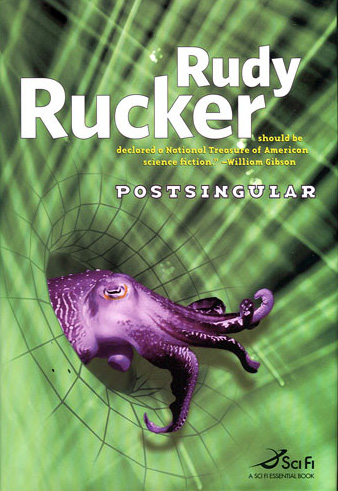
PostSingular
by Rudy Rucker
Published in 2007
Published by Tor

PostSingular opens with young engineering wizzes Jeff and Carlos attempting to launch a homemade rocket. Things go horribly wrong and Carlos is killed. This becomes the defining moment in young Jeff Luty's life. Do we now have our main protagonist? Will PostSingular be the story of heroic scientist Luty working to improve humanity while cherishing the memory of his lost childhood friend?

Nope. Jeff Luty grows up twisted and evil. He convinces the corrupt President Dick Dibbs of the USA to deliver to Mars some nanobots ('nants') that he's developed. They will swarm over the planet, disassemble it, and turn it into a gigantic computer for humanity's use. That's the version of his plan for public consumption, at least. What actually happens next is that the nants, fresh from eating Mars, start to devour the Earth and every living thing on it. Humanity is to be resurrected inside a virtual world under the benevolent rule of Dick Dibbs.

But Luty didn't count on his employee Ond Lutter, a genius troubled by something that almost resembles a conscience. He works out a code that will halt and reverse the onslaught of the nants. His autistic son Chu, whose mind bends in precisely the right ways, memorizes his dad's formula before the nants devour him. The resulting indigestion that his mind gives Luty's nants undoes all the damage that they have done. Humanity is saved. Happy ending.

Did I just summarize the entire plot of the book? Hahahahaha. That was just the first twenty pages. Things get much, much weirder when the main plot commences shortly afterwards.

PostSingular imagines a future where the astonishing happens, society adapts and becomes inured to it, and then the more astonishing happens. Repeat cycle.

For example, we see the introduction of a new technology that (among other things) allows you to see what's happening anywhere else in the world. Effortlessly. And yes, of course this includes watching your friends and neighbors have sex. (It can be blocked, but it takes industrial-strength technology that most people don't have access to.) But with the passage of time, as far as regular people are concerned it becomes the new normal. Most of the novel takes place after everybody's already used to it.

Bizarre piles on top of bizarre amid plenty of sharp narrative turns (the twentysomething hipster who's the closest thing the novel's got to a main protagonist doesn't appear until a third of the story has gone by) that Rucker somehow manages to avoid turning into a great big trainwreck. A fine stab at helping us appreciate the strangeness of life after the Singularity


The Constant Gardener
by John le Carre
Published in 2001
Published by Hodder & Stoughton
ISBN: 0-340-73337-3

And now for something completely different.

The Constant Gardener deals with murder and intrigue among the British diplomatic community in Kenya. It opens with the gruesome murder of Tessa Quayle, a prominent young British activist who had worked tirelessly on behalf of the poor and downtrodden of East Africa. Her husband Justin is a staid and proper functionary in the British embassy who had kept himself deliberately aloof from his wife's work. Now that she is dead, Justin takes an extended leave of absence to investigate her killing.

For whatever reason, from about the halfway point onward Justin Quayle was being played in my mind by Colin Firth, even though I know in official Movie Land he looks like Ralph Fiennes. I dunno, my mental image of the character just fits Colin Firth better.

I approve of John le Carre's ability to construct complex plots, although I will admit that I failed to ever get into the Cold War-era spy novels which he will certainly be best remembered for. I enjoyed The Tailor of Panama when I read it a couple of years ago, and The Constant Gardener is a similarly good standalone novel. I read it without knowing the plot ahead of time, which results in some enjoyable plot twists and turns (the initial viewpoint character, one Sandy Woodrow, turns out to not be the main protagonist but rather an antagonist, and a slimy one at that).

This is a very political novel and the bad guy is Big Pharma. I am personally far too ignorant to opine much about the ethics practiced by the big pharmaceutical companies without very likely making an ass of myself. In my last job I met a couple of people who worked at the main Taiwan office of one of the world's great pharmaceutical companies; more than one of them brought up ethical lapses that their competitors committed in order to make the point that their own company didn't do that sort of thing. Who knows. Maybe employees of every other pharma company would've told me the exact same thing.

Friday, December 7, 2012

Trollology

Slate.com's Farhad Manjoo has taken people to task for calling him a 'troll' for writing an article that bashed iTunes. He complains that the word 'troll' used to mean something -- why debase the word now by using it on everyone you happen to disagree with?

I agree. I am old enough that I remember, back in the 1990s, when the word 'troll' had a very specific and useful meaning, which I shall explain in a moment.

But in the first decade of the new century, the definition of 'troll' expanded to include sociopaths who enjoyed using the Internet to make innocent people's lives miserable. I'm not defending that practice, of course, but every time you expand the definition of a word, it becomes less useful. That's why I was never happy calling those people 'trolls'.

And of course, as time passes it gets more common to call other people 'trolls' when all they've done is voice an opinion you didn't like hearing. Now the word means close to nothing anymore.

Here's the original meaning of 'troll', as I understood it. Imagine, for a moment, that the 2012 Presidential election is still going on.

SCENARIO ONE

I like to annoy people.

I find a thread that's full of fairly intelligent Obama supporters (and nobody knows me) and I write, 'Obama is a MUSLIM SOCIALIST EXTREMIST and all of you dumb liberals ARE RUINING THIS COUNTRY!!!!!'

Then I run away (figuratively speaking), giggling.

Of course I'm a troll. Nobody's going to dispute that.

SCENARIO TWO

I like Obama. I think Romney supporters are dumb and I wish to express that through trolling.

I find a thread that's full of fairly intelligent Obama supporters and I write, 'Obama is a MUSLIM SOCIALIST EXTREMIST and all of you dumb liberals ARE RUINING THIS COUNTRY!!!!!'

Then I run away (figuratively speaking), giggling all the while.

Am I a troll? Yes.

SCENARIO THREE

I like Romney. I think Obama is a Muslim socialist extremist and he's going to ruin the country. I think Obama supporters are dumb and I wish to annoy them through trolling.

I find a thread that's full of fairly intelligent Obama supporters. Just to piss them off, I write, 'Obama is a MUSLIM SOCIALIST EXTREMIST and all of you dumb liberals ARE RUINING THIS COUNTRY!!!!!'

Then I run away (figuratively speaking), laughing as I think about all of those stupid liberals gnashing their teeth at my having broken into their echo chamber and spoken truth to them.

Am I a troll? Yes. Even though I agreed with what I wrote, I had no intention of actually engaging with anybody in an authentic way. I just wanted to piss people off.

SCENARIO FOUR

I like Romney. I think Obama is ruining the country. I am very concerned about this. I don't understand why liberals are supporting a Muslim socialist extremist who wants to ruin the country.

I spend a great deal of time composing an eloquent appeal to Obama supporters to rethink their support for this man. And that's why, in the end, I find a thread that's full of fairly intelligent Obama supporters and post: 'Obama is a MUSLIM SOCIALIST EXTREMIST and all of your dumb liberals ARE RUINING THIS COUNTRY!!!!!!'

I never said I was good at crafting an argument.

Am I a troll? No. I have a sincerity that was lacking in the first three scenarios. However, thanks to my lack of eloquence, my non-trollness will not be obvious to anyone else. Whether I'm a troll or not is determined by my intention, not by how it looks to other people.

NOW THAT I CLEARED THAT UP...

When people started interacting online in large numbers in the 1990s, many people were entranced by the fact it was now possible to say dumb stuff without any negative social consequences. Loads of people got their giggles this way.

Loads of people still get their giggles this way. I'm not defending or advocating it. I am simply saying that it exists, and as long as it exists, let's acknowledge it by having a word for it.

As long as we remember that the determining factor is intentions, not appearances, I think calling these people 'trolls' will do nicely. Let's not dilute the word by using it on everybody who says stuff we don't like.

Friday, November 30, 2012

My Responsibility

A couple of weeks before the election, I read Conor Friedersdorf's essay 'Why I Refuse to Vote for Barack Obama'. I posted it to Facebook. I wanted people to read it.

In the election, I voted for Barack Obama. I don't have buyer's regret. I'm happy he won, although I admit the Romney campaign worked far harder to lose my vote than Obama did to win it. (I know I could have voted for a third party, but I looked at the two politicians who actually had a shot of winning and found Obama preferable enough that I wanted to influence the two-man race directly.) So why did I propagate Friedersdorf's essay?

Because I thought people needed to get the best anti-Obama case straight-up. Friedersdorf's not a silly Rush Limbaugh type going on about the government giving kids free birth control (and notably, he didn't find Mitt Romney acceptable either). Instead, he goes straight for the jugular, attacking the most uncomfortable aspects of Obama's foreign policy. A Republican President arguably would have been just as bad, but that's a weak excuse.

Friedersdorf did not convince me not to vote for Obama, but he did make me think. He made me more aware. That is a very good thing.

I'm a fan of both of podcaster Dan Carlin's shows. In the last episode of his political podcast Common Sense before the 2012 election, he said something to make me pause. Carlin, who is of the opinion that both major political parties are hopelessly corrupt, said that while he couldn't stomach the idea of voting for either Obama or Romney, he thought that if he had to choose one or the other, he would rather see Romney win.

Carlin is concerned about the erosion of American civil liberties under the banners of the War on Drugs and the War on Terror, two 'wars' that he feels have done immense damage to American society. He doesn't think he would approve of Romney's policies any more than Obama's. However, he does feel that civil libertarians on the Left -- a large and substantial group -- would hold Romney accountable for the same actions that they give Obama a pass on. There would be far more demands from civil society to expose the government's dirty laundry under a Romney administration than there are under an Obama one.

Putting aside the issue of whether Obama has really been so bad for civil liberties or not, I do believe Carlin is basically right here. The three main points that Friedersdorf makes against Obama in his essay (terrorizing Pakistani civilians, extrajudicial killing of Americans, and authorization of military forces without Congressional approval) are ones that would have made many Democrats absolutely furious if the President for the last four years had been George W. Bush or John McCain.

This isn't some pathology endemic to left-wingers. What about all those Republicans who cheerfully went along with whatever George W. Bush did for eight years, but when Barack Obama became President they decided Our Country Is In Danger because of Ballooning Debt and Losing Our Basic Liberties?

That's why I've made a decision:

I stand by my vote for Barack Obama. I believe he was the clear better choice. But, you know those bumper stickers and T-shirts you can buy that say, 'Don't blame me! I voted for [name of loser of last election]'?

Well, I voted for Obama and I'm happy he won. Please, blame me.

Don't bother hurling random anti-Obama crap at me. What blowhards like Rush Limbaugh and Sean Hannity say bears no relation to reality.

No, I want to hear the real stuff. I want to find out about government policy that makes real people miserable. I want to hear about the people who die. I want to hear the bad things my government is doing.

I don't want to be one of those jerks who thinks it's OK for the government to misbehave as long as the guy I voted for is in power.

I want to know the bad things. I want to be made aware. I voted for this government. It's my responsibility.

Thursday, November 29, 2012

Little Fuzzy

Little Fuzzy
by H. Beam Piper
Published in 1962
Published by Avon
ISBN: 0-441-48498-0

On the Earthlike planet of Zarathustra, currently in the early stages of being colonized and exploited by human beings, crusty old prospector Jack Halloway befriends a little woodland creature who decides to move into his remote cabin. The creature, who Halloway names Little Fuzzy, likes the food and safety of Halloway's residence so much that soon he brings his whole family unit to live there as well.

Jack Halloway and his scientifically-minded pals are intrigued by the Fuzzies' tool use and problem solving skills, and declare that they believe the Fuzzies to be an indigenous sentient race.

Enter the Chartered Zarathustra Company, which owns the entire planet and supervises all economic activity conducted there. It seems that humans have colonized planets with Stone Age natives before, and while there is no Star Trek-style Prime Directive in this universe, there do exist laws meant to protect the interests of technologically-challenged aborigines. If the Fuzzies are sentient, the planet will become a protected area and the Company will lose their exclusive rights.

Soon an exceptionally stupid Company bureaucrat kills a Fuzzy, Jack Halloway wants to see him tried for murder, and the court case which will determine the future of Zarathustra has begun.

Little Fuzzy is considered something of a classic among literary science fiction aficionados. It raises the issue of how one defines a sentient being, and what distinguishes a genuine Stone Age culture from merely a bunch of super-smart animals. (At times, the speculation on intelligence and sentience reminded me of the last novel I read, Peter Watts' Blindsight, though the two books couldn't possibly be further apart stylistically.)

The novel is engaging, and frequently amusing, and has a fast-paced plot. Apart from the one unavoidable bit of bloody violence, the book lightheartedly bounces along. For all of Jack Halloway's worry about the Fuzzies, the book doesn't have a whole lot of dramatic tension, and looking back afterwards, it's really not clear that the bad guys' efforts to have the Fuzzies declared nonsapient ever had a chance of succeeding.

I found the ending dissatisfying. I wonder if the book was showing its age. I get the feeling that in 1962, paternalistic attitudes towards non-Western, traditional cultures were still fairly acceptable, even in circles that considered themselves broad-minded.

Fuzzies are cute. Everybody in the book perceives them as adorable little things, and it doesn't help the case to have them declared legally sentient if people don't take them seriously due to their severe case of cuteness.

But I had a strong sense that even the most sympathetic characters still didn't take the Fuzzies seriously at the end of the book. In the final pages, the newly-appointed Commissioner of Native Affairs -- Jack Halloway, of course -- complains to a friend, 'Everybody wants Fuzzies; why, even Judge Pendarvis approached me about getting a pair for his wife. There'll be gangs hunting them to sell, using stun-bombs and sleepgas and everything. I'm going to have to set up an adoption bureau; Ruth will be in charge of that...'

So, if I'm understanding this correctly: Human colonists on Zarathustra think the darling little Fuzzies are adorable and want to keep them as pets, and Jack Halloway is going to let people do this legitimately, so as to prevent an illicit pet trade that would hurt the Fuzzies. His intentions are very noble and all, but does this seem right, given that the point of the whole book is 'Fuzzies are people'?

Even in the best-case scenario -- poor orphaned Fuzzy has no one to care for them, gets legally adopted by kind Human couple -- we're still displacing these people from their native culture.

A culture, I might add, that we know literally nothing about. By the end of this book, there still hasn't been a single meaningful Human-Fuzzy conversation beyond pantomime.

We know they're smart, conscious beings. We know shockingly little apart from that. And we're seriously talking about putting them in human homes to be raised by human beings?!

Piper wrote two sequels to Little Fuzzy, in which I can hope he dealt with some of these issues. (Even if he did, my view is that a novel ought to be able to stand on its own merits.) What I'm interested in reading, even more than the Fuzzy sequels written by Piper and others, is John Scalzi's 2011 reboot Fuzzy Nation, in which he retold Piper's story in the way he saw fit. Scalzi's take on the story will undoubtedly be entertaining and might help clarify my own thoughts on Fuzzyology.

Monday, November 26, 2012

Blindsight

Blindsight
by Peter Watts
Published in 2006
Published by Tor Books
ISBN: 978-0-7653-1218-1

It's the late 21st Century, and the aliens have arrived. They made their presence clear by deploying thousands of satellites to conduct a full survey of Earth and its inhabitants. Humankind is thoroughly spooked and sends out a ship full of Earth's best and brightest to intercept the alien mothership, just discovered in the outer reaches of the solar system.

But because this is the late 21st Century, humanity's best and brightest are now weirder than the aliens in most science fiction novels not written by Peter Watts. There's a linguist who, to do her job more effectively, has split her mind into four fully independent selves. There's a biologist who has enhanced his sense perception to such a ludicrous extent that there's no brain left over to feel the tips of his own fingers. If you have a hard time feeling empathy for this bunch, that's okay; the feeling is most likely mutual.

Our narrator and chief protagonist has had such vast areas of brain removed and replaced with machinery that it's debatable whether he is still a fully sentient being or his life is one long extended Turing Test that he's done a pretty decent job passing so far.

And as for the crowning achievement in this novel's worldbuilding: Tens of thousands of years ago, there was a subspecies of humanity that was adapted to prey upon humans like us. Sort of like Neanderthals, but meaner. Because they lacked the ability to synthesize a crucial neural chemical, they were required to hunt and eat humans to survive. Their brains worked very differently from standard Homo sapiens, and they had remarkable pattern-matching abilities and animal cunning so that they could easily outwit their prey. So as not to exhaust their supply of food, they had the ability to hibernate for years, even decades at a time. They died out when we regular humans realized that the visual centers of these predators' brains couldn't handle Euclidian geometry, and if forced to look at right angles, they would have epileptic seizures. But we never forgot about them. In the 21st Century, we decided to clone these guys, Jurassic Park-style, in order to put their intelligence to work in fields that could use their unique cunning.

Anyway, long story short, they've put a vampire in charge of the ship. An actual, literal vampire. Think Nosferatu rather than Edward Cullen. I hope you all are okay with that and don't mind taking orders from him and sharing extremely limited living space with him. Vampires have been put in charge of most of the important stuff back on Earth, after all, so we know they're trustworthy.

Blindsight is an audacious novel that works remarkably well. The main theme of the book is consciousness, and intelligence, and what it means to have a high degree of the latter without the former being present. Is it possible for creatures who are not wired to think recursively about themselves to build an interstellar civilization? Watts has presented 'incomprehensible mindset' aliens about as well as anyone I've ever seen.

The book reminded me of Housuke Nojiri's Usurper of the Sun, which I read last year. Both delved into speculation on how truly alien aliens might operate. I was a little disappointed with the ending of Nojiri's novel, where the incomprehensible becomes comprehensible, articulate, even a bit cute, far too easily for my liking. Nothing of the sort happens in Watts' novel.

Blindsight has a 'love and cuddliness' quotient of zero.

There is no happiness to be found in these pages. No hope, and no optimism, and the only positive emotion is a purely intellectual spirit of discovery, unless you also count the sizable portion of black humor. Depending on your own mindset and background, you might find there are no sympathetic characters at all. You may or may not find that turns you off. Me, I found the book intellectually stimulating, and I look forward to finding more of Watts' work in the future.

Monday, November 19, 2012

Dictionary of the Khazars: A Lexicon Novel

Dictionary of the Khazars: A Lexicon Novel
by Milorad Pavic
English translation by Christina Pribicevic-Zoric
Published in 1984 (in English in 1988)
Published in English by Vintage International
ISBN: 0-679-72461-3

The Khazars were a people who ruled a large state in eastern Europe over a thousand years ago.

That much is true history. Everything that follows is fiction. I'm going to quickly summarize the plot as I understand it. Bear in mind that the novel is constructed very non-linearly, and I personally didn't grasp the 'big picture' until I'd nearly finished the book, so some might consider the next two paragraphs to be spoilers.

In the 17th century, three individuals (one Christian, one Muslim, one Jewish) attempted to compile a history of the Khazar people, particularly the details surrounding the conversion of the Khazar government to Judaism in the late 8th/early 9th centuries (possibly an actual historical event). This history was published and subsequently suppressed.

Three hundred years later, three scholars grew interested in the 'Khazar question' and attempted to instigate new research into the Khazars. All plotlines converge in a series of violent events in an Istanbul hotel one morning in 1982.

That much I am sure of. There is a great deal more going on in the book, much of it concerning the metaphysics of dreams, with (possibly) a great deal of eastern European folklore thrown in as well. I think.

The book is divided into three sections: Christian, Muslim, and Jewish sources on the Khazar Question. Within each section, entries in alphabetical order give varying points of view on: a) medieval Khazar history, b) the 17th-century individuals compiling Khazar history, and c) the 20th-century individuals compiling Khazar history.

Throughout, the writing style is one that makes liberal use of surrealistic asides and references to fantastical events. As I mentioned, I feel like a lot went right over my head due to my ignorance of folkloric traditions, although it is also possible that many of the odder asides are veiled references to other sections of the narrative, and might become clearer on a second reading.

Another thing to remember is that author Milorad Pavic was Serb, and apparently his fictional Khazaria is to a certain extent a satire of Serbia. Pavic's Khazar state exists under an unusual administrative system that guarantees that non-Khazar ethnic minorities legally dominate ethnic Khazars, despite the fact that Khazars outnumber all other ethnic groups combined. Presumably this is a satire of Yugoslavia before it collapsed, although my knowledge of that part of the world and that period of history is far too meager for me to appreciate it.

To those who are midway through Dictionary of the Khazars and are struggling, do not worry! There is indeed a coherent plot, although you may be finishing up the novel's final third before you can clearly see its structure. As for me, I think the best thing for me to do might be to put it to one side for a few months, then pick it up again and start re-reading from the beginning. I suspect I'll get far more out of it on my second time through.