The TED talks that have really stuck with me, really gotten under my skin, that deal with the realm of business:
Dan Pink talks about how to motivate people in jobs that require creativity. The "monetary rewards fail miserably at motivating people to be creative" theme recurs among several talks at TED, including Tom Wujec's analysis of the Marshmallow Challenge:
The Marshmallow Challenge (one of two marshmallow-centered TED talks; not to be confused with the other one) forces people to collaborate constructively in a very tight timeframe, and there are all sorts of interesting lessons to be gleaned from who tends to do well at the challenge and under what circumstances.
Here's my favorite talk that's specifically about marketing and branding:
Simon Sinek makes a lot of sense. Still, it's hard not to be cynical about his mention of Apple Computers. "Everything we do, we believe in challenging the status quo." Simon Sinek gave this talk in 2009, I'm writing this in 2011, and while Apple would dearly like to have us believe that they are challenging the status quo, the truth is that for the last few years they have been the status quo.
Finally, Jason Fried's great talk. I've had a lot of fun showing this to Taiwanese office workers. Ordinary office workers generally agree with everything he says. One student of mine, a senior VP at the Taiwan Stock Exchange, found quite a bit to quibble with, but it was great to see he still engaged with the talk fully.
I like Fried's style. Not a single PowerPoint slide, or indeed any visuals whatsoever. I think this talk should be required viewing by everyone in a position of authority at large organizations. You can disagree with points he makes, but at least you'll have to think about his message.
Saturday, March 12, 2011

Thursday, March 10, 2011
Storytelling
I saw The King’s Speech the other day. I enjoyed it a lot, despite the story’s adherence to Hollywood formula. What do I mean by Hollywood formula? From years of movie-going experience, I knew that Bertie, the stammering Prince who would eventually take the throne as King George VI, would after initial strong doubts gradually come to trust his speech therapist, and then for a silly reason Bertie would almost abandon that trust. But his doubts would turn out to be short-lived, and he would quickly return to his therapist's embrace.
But I'm a sucker for period pieces, and I didn't once wish that the movie would hurry up and end. So there’s that.
Of course the film takes some liberties with the historical record; Wikipedia devotes a whole section to them. The relationship between Bertie and Lionel Louge began in the 1920s, long before the film had them meeting. Bertie’s family life is simplified; he actually had two more younger brothers and one sister who the film never showed or mentioned. And history that’s deemed irrelevant to the plot gets left out. If you didn’t know better, you might get the impression from the film that World War II broke out just weeks after Bertie became king.
(There is also the fact that younger brother Colin Firth, born 1960, clearly looks older than elder brother Guy Pearce, born 1967, a fact that most film critics have been too polite to point out.)
But that’s all easily forgivable. A historical film that’s just as nuanced as real life would probably be unwatchable. Tora Tora Tora, which I remember being shown back in high school, is probably as historically accurate as movies get -- but the events it depicts take place within 24 hours. And even so, it's admired far more for its historical veracity than for being a crowd-pleaser.
But that’s not what has many people riled up. Christopher Hitchens, while praising the fine moviemaking at work, criticizes the film for how it portrays late-1930s British politics, particularly Churchill’s views on the Edward VIII abdication crisis and the new king’s views on appeasing Hitler. (George VI strongly supported appeasement, not that you’d know it from the movie.)
If that bothers you, do what I do: see the movie as pure fiction. Oh, of course it’s inspired by real events. But plenty of fiction is inspired by real events. Then the real events are molded and shaped to fit the narrative.
Like in The Social Network.
I saw The Social Network, I really enjoyed it, but after I learned that the real Mark Zuckerberg has been dating the same woman since before he started Facebook, I couldn’t take the film remotely seriously as corresponding to real events. And there’s nothing wrong with that.
Screenwriter Aaron Sorkin has famously said, of The Social Network, "I don’t want my fidelity to be to the truth; I want it to be to storytelling. What is the big deal about accuracy purely for accuracy’s sake, and can we not have the true be the enemy of the good?" I for one was happy watching Jesse Eisenberg play a fictional character at the movie's center. And I remembered not to confuse the fictional story with real life; as Cracked has pointed out, The Social Network arguably makes Zuckerberg look better and more interesting than he deserves.
Even supposedly nonfiction books are often more story than unimpeachable history. I once read a 200-page biography of Queen Victoria that blatantly skipped over history and reduced supporting characters to caricatures in order to create an interesting narrative. You can hardly blame the author. You can’t fairly reduce a real person’s life to 200 pages, unless you’re dealing with a stupendously boring person. And people want to read, and see, narratives that make sense.
That said, if you don’t know anything about a person or period from history, a movie can at least impress an outline upon your brain, which can be filled in afterward with details of what really happened. After the movie 300, which I would argue is barely a historical drama at all (it’s an adaptation of a highly stylized graphic novel), Zompist helpfully provided some facts about how it compared with actual history, ending with the dry comment, “Despite the film, the Persian army did not actually have orcs”.
But I'm a sucker for period pieces, and I didn't once wish that the movie would hurry up and end. So there’s that.
Of course the film takes some liberties with the historical record; Wikipedia devotes a whole section to them. The relationship between Bertie and Lionel Louge began in the 1920s, long before the film had them meeting. Bertie’s family life is simplified; he actually had two more younger brothers and one sister who the film never showed or mentioned. And history that’s deemed irrelevant to the plot gets left out. If you didn’t know better, you might get the impression from the film that World War II broke out just weeks after Bertie became king.
(There is also the fact that younger brother Colin Firth, born 1960, clearly looks older than elder brother Guy Pearce, born 1967, a fact that most film critics have been too polite to point out.)
But that’s all easily forgivable. A historical film that’s just as nuanced as real life would probably be unwatchable. Tora Tora Tora, which I remember being shown back in high school, is probably as historically accurate as movies get -- but the events it depicts take place within 24 hours. And even so, it's admired far more for its historical veracity than for being a crowd-pleaser.
But that’s not what has many people riled up. Christopher Hitchens, while praising the fine moviemaking at work, criticizes the film for how it portrays late-1930s British politics, particularly Churchill’s views on the Edward VIII abdication crisis and the new king’s views on appeasing Hitler. (George VI strongly supported appeasement, not that you’d know it from the movie.)
If that bothers you, do what I do: see the movie as pure fiction. Oh, of course it’s inspired by real events. But plenty of fiction is inspired by real events. Then the real events are molded and shaped to fit the narrative.
Like in The Social Network.
I saw The Social Network, I really enjoyed it, but after I learned that the real Mark Zuckerberg has been dating the same woman since before he started Facebook, I couldn’t take the film remotely seriously as corresponding to real events. And there’s nothing wrong with that.
Screenwriter Aaron Sorkin has famously said, of The Social Network, "I don’t want my fidelity to be to the truth; I want it to be to storytelling. What is the big deal about accuracy purely for accuracy’s sake, and can we not have the true be the enemy of the good?" I for one was happy watching Jesse Eisenberg play a fictional character at the movie's center. And I remembered not to confuse the fictional story with real life; as Cracked has pointed out, The Social Network arguably makes Zuckerberg look better and more interesting than he deserves.
Even supposedly nonfiction books are often more story than unimpeachable history. I once read a 200-page biography of Queen Victoria that blatantly skipped over history and reduced supporting characters to caricatures in order to create an interesting narrative. You can hardly blame the author. You can’t fairly reduce a real person’s life to 200 pages, unless you’re dealing with a stupendously boring person. And people want to read, and see, narratives that make sense.
That said, if you don’t know anything about a person or period from history, a movie can at least impress an outline upon your brain, which can be filled in afterward with details of what really happened. After the movie 300, which I would argue is barely a historical drama at all (it’s an adaptation of a highly stylized graphic novel), Zompist helpfully provided some facts about how it compared with actual history, ending with the dry comment, “Despite the film, the Persian army did not actually have orcs”.
Friday, March 4, 2011
Best of TED: Education
Over the past year or so, I've watched a huge chunk of the online talks at TED.com. Not all of them, but many, and some more than once.
Here are some of the ones that never let go. In this post, I'll look at a few about education.
All are worth your time. Many were interesting to watch, but didn't affect me much in the long run. But some lodged themselves in my mind, tenacious, not letting go.
Sir Ken Robinson gave the above two talks several years apart, but there is one running theme throughout. Think of them as two halves of one talk.
The case he makes that school reform is necessary is, to me, so intuitive, so obvious, that I wish every country's school system could be disassembled, reduced to its component parts, and then rebuilt according to the dictates of Sir Ken and some like-minded friends.
The idea that there are many children who are very bright, very creative, very capable, but don't do well on standardized tests, is an easy one for me to grasp. Because that's basically me, just in reverse. Okay, am I saying I'm not bright? I'm not creative and capable? Not exactly.
But I do seem to have one special talent. One thing that I excel at. One thing that I do really, really, really well. And that is taking standardized tests. Especially the kind where you have to fill in the correct bubble with your #2 pencil. I do great on those.
I don't deserve to.
I wasn't a great student. By that, I don't mean I was a naturally bright kid who found the material really easy to grasp and as a result didn't pay attention to teachers and didn't bother with homework. I know there are lots of kids like that being served badly by their schools, but that wasn't me.
No, I found many classes difficult, including classes I should have found easy. I seem to have a natural aptitude for mathematics, but I crashed and burned in physics and calculus courses. (I blame myself, but that's a whole different story.) I find it absolutely believable that there are many, many kids out there now who are bright and creative and yet struggle horribly on standardized tests.
Also, let's face it: a university education is right for many people, but it's not necessary for everybody, and people who don't have a bachelor's degree are of no less worth than those who do. I'm all for vocational education gaining more respect in society. I'm not good with my hands. I can't build or repair things. I have awe and respect for those who can. Let's get rid of this phony-baloney animosity in our society between university-educated people and so-called blue-collar workers. That time when a whole class of human beings spent their days mindlessly filling slots on an assembly line is over. Okay, in many parts of the world it's not over yet, but it ought to be made over as soon as possible. All human workers ought to have jobs that call for creativity and skill.
Speaking of education, let's talk about math education.
Arthur Benjamin here points out that math education in our schools is organized in a procession that looks something like this: Arithmetic, algebra, geometry, advanced algebra, CALCULUS! All hail calculus! Calculus, the crowning glory of all mathematics!
Yeah, right.
I haven't used what I learned in calculus class since my last day of calculus class. Which is not to knock calculus -- it's incredibly important in many fields -- but it shouldn't be considered basic cultural literacy. Calculus isn't something every adult with a functioning cortex ought to know.
Statistics is.
Don't believe me? We all use statistics in our everyday lives, generally without even realizing it. Our news media constantly bombard us with information presented in the form of statistics, and we're just expected to understand it. Arthur Benjamin has just enough time in his talk to sing the glory of statistics, but he doesn't have time for specifics.
Which brings us to Peter Donnelly's talk.
Statistics. Is. Important. After initially demonstrating that most people don't know much about the subject, he delivers some absolutely devastating evidence for its importance.
And yet I've never taken a statistics course in my life. Oh, I know the difference between 5 percent and 5 percentage points. I understand that if you raise a number by 20%, and then lower it by 20%, you don't have the same number that you started with. And I can read (most) graphs. But I'm still pitifully ignorant. There are plenty of grown-ups out there who know as little as me AND seem to have no intellectual curiosity, who still go out and vote and serve on juries.
If we're going to have a society that presents information statistically, then let's try to get people to understand that information, 'kay?
A Heartbreaking Work of Staggering Genius by Dave Eggers
 Yes, it's a novel. I feel I have to put my foot down very strongly on that point because, if I get into a reasoned debate with someone over whether or not it constitutes a "novel", I'll probably lose. So let it be said that Dave Eggers' A Heartbreaking Work of Staggering Genius is a novel, and will remain a novel for the remainder of this post.
This novel (said with unnecessary emphasis) appeared in bookstores when I was in college, and I remembered it due to that title. For the next decade, I did not read it. I did remember Dave Eggers' name, although for some reason I often got him confused with David Sedaris. Eventually I read his (Eggers', not Sedaris') brilliant The Wild Things, saw him on TED.com, and finally read the novel that made him famous.
In The Wild Things, Eggers showed his brilliance at capturing being a rambunctious young boy. (I wasn't all that rambunctious when I was a kid, but Eggers' portrayal had enough verisimilitude for me.) In AHWoSG, the book that made him famous, Eggers brilliantly captures being a financially strapped bright 20-something in a mid-1990s San Francisco that I never experienced, but is so cool that I can only regard it as a legendary place. (How cool and legendary is Eggers' mid-1990s Bay Area? Eggers name-drops Mark Frauenfelder of Boing Boing long before Frauenfelder or Boing Boing became nationally known. That's how cool and legendary.)
Of course, the novel isn't about the Bay Area of fifteen years ago; it's about how Eggers is thrust into the responsibilities of adulthood on one hand as he becomes his rambunctious little brother's de facto if not de jure guardian, while on the other hand doing his best to live the life of a not-quite straight-laced twentysomething (I am trying hard not to use the word "hipster"). Eggers delves deep into his own character, while creatively departing from the strict historical record just often enough that I don't feel dishonest in calling the book a novel. Novel novel novel!
Monday, February 21, 2011
Novel 5: Aloft by Chang-rae Lee
 Once again I have managed to read a novel that is based entirely around the protagonist and his interactions with the world around him. Instead of a plot. As a result, I'm not really sure what I can write about here.
Oh, I didn't hate Aloft. Far from it -- I was caught up in Chang-rae Lee's prose, and I read it in two days. My problem is that I never know how to discuss books or stories that are not plot-heavy.
Lee's first novel, Native Speaker, while primarily about characters, had great loads of plot and industrial espionage and corrupt New York City politics. I know how to talk about that.
His second novel, A Gesture Life, was a character study, against settings both larger-than-life (WW2 Burma) and not so (suburban New York).
Aloft takes place entirely among the denizens of Long Island, and their lives and relationships and illnesses, and --
And as much as I was immersed in Lee's writing, I don't have the faintest idea what to say about it.
Monday, February 14, 2011
Novel 4: Practical Demonkeeping by Christopher Moore
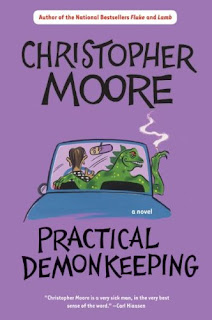 I cheerfully admit Christopher Moore is not the most highbrow of novelists. I don't care. As much as I love losing myself in Vikram Seth's beautiful prose, I know deep in my heart that I will never write like him. On the other hand, if I get myself into the habit of writing fiction every day, there is no doubt in my mind that eventually I'll be able to write every bit as well as Christopher Moore, and in much the same genre, too.
 Practical Demonkeeping was Moore's first novel. It's the book that made him well-known. It's my own third Moore novel, after Fluke, the story of Hawaii-based whale researchers and the bizarre things they find, and Lamb, the gospel according to Biff, Jesus Christ's exceedingly vulgar best friend who followed the Savior everywhere. I enjoyed both books immensely.
Practical Demonkeeping is the story of a tourist-trap town in California and how the residents react to the arrival one day of the demon Catch, along with his master Travis, who has spent the last seventy ageless years fruitlessly trying to get rid of him. It's well-crafted, but somehow I'm left with the sense that Moore hadn't yet grown into his own style.
On the one hand, Practical Demonkeeping doesn't contain the one plot point common to both Fluke and Lamb: a woman who decides to become a lesbian after witnessing something horrific involving penises. (I don't think that's how lesbians work in the real world.)
On the other hand, I didn't feel like I was reading a book by the author of Fluke and Lamb. Instead, I felt like Carl Hiaasen had decided to try his hand at setting a novel in California rather than Florida, and also add a supernatural element just to see if he could make it work. I'm not complaining. I like Carl Hiaasen.
But it was interesting to see an early stage in the evolution of an author's style, rather than just his ability.
Sunday, February 13, 2011
Nonfiction 5: Stumbling on Happiness by Daniel Gilbert
 "Despite the third word of the title, this is not an instruction manual that will tell you anything useful about how to be happy. Those books are located in the self-help section two aisles over, and once you've bought one, done everything it says to do, and found yourself miserable anyway, you can always come back here to understand why."
-- Foreword, pp. xvi - xvii
Stumbling on Happiness is the third book in my self-imposed "It's the Mind" trilogy. I think I'm ready to take a bit of a break from tales of psychology experiments conducted on unsuspecting college students. (A lot of psychology experiments involve experimenters acting like amazing jerks to unsuspecting volunteers, have you noticed?)
If you like that, his book explores the same topic in more detail. (And while we're on the subject, also check out behavioral economist Daniel Kahneman's fascinating TED talk.)
Gilbert's book is unfortunately blending with Jonah Lehrer's How We Decide in my mind. Clearly we see the perils of reading a bunch of similarly-themed books at once. I suppose this means I'd better let a couple of months pass at least before picking up, say, Dan Ariely's Predictably Irrational, or any other entry in the genre.
Which is too bad, because Gilbert's book may be the best of the three, or at least the most useful. Gilbert takes the time to convince us that every single one of us - or at least, those of us who are human beings - mistake our brains' confabulations for actual objective reality. We could all stand to be reminded of that from time to time.
Friday, February 11, 2011
How We Decide by Jonah Lehrer
 I was a few chapters into How We Decide when I started thinking, "Haven't I read this before"?
A while back I read Malcolm Gladwell's anecdote-studded book Blink, whose thesis is that people often make far better decisions on the basis of intuition and "gut feeling" than when they carefully and consciously weigh the evidence. (And sometimes they don't -- Gladwell brings up Amadou Diallo as an example of somebody who died because men with guns followed their gut instincts when they shouldn't have.)
Jonah Lehrer, in the book's early chapters, discusses virtually the same idea. (Different anecdotes.) But his focus is different.
The fun-to-make-fun-of Gladwell made his name by packaging insights about people and society into easily digestible books and articles for the middlebrow masses. (I'm not making fun of the middlebrow masses. I belong to them.) He's a jack-of-all-trades. He writes about politics. He writes about culture. He spoke at TED about spaghetti sauce. And when he finally got lots of people pissed off at him, it was because of an article he wrote deriding Twitter's ability to make real change in the world.
Lehrer, on the other hand, specializes in minds and brains. He's got a solid background in neuroscience. He may never be famous enough to be mocked by The Onion, but he aims for the same middlebrow audience as Gladwell -- except you know that he knows his stuff. I read his blog.
Many of Lehrer's anecdotes are familiar to people who follow current developments in neuroscience and behavioral economics. My personal favorite: a university did a study where a sugar and caffeine-laden energy drink was available to students - for a price - just before the students did a battery of mental problems. One set of students bought the energy drinks at full retail price; the other set got them at a substantial discount. The exact same sugar and caffeine jolt both ways, but the students who paid full price did significantly better on the quiz than the ones who got the discount.
Another interesting finding: when test subjects (college students again) did a blind taste test of different varieties of strawberry jam, their preferences tallied closely with the preferences of the taste experts that Consumer Reports employs. That in itself is comforting news -- apparently the taste of these hifalutin' experts is not too different from that of unschooled hoi polloi like us. It got interesting, however, when another group of tasters were asked to provide reasons for why they preferred Brand A to Brand B when they assigned their ratings.
Analyzing taste sensations using language is difficult. I like food and I like going to restaurants, but I couldn't be a restaurant critic; I don't know how to talk about food. When these college students, largely unschooled in the science of flavors, were forced to justify their rankings using language, something happened. Jams that they ought to have liked plummeted. Jams that experts and ordinary college students alike had panned, were now among the most popular. These students were unable to put their instinctive reactions into language, so they reached, concocted explanations, and fooled themselves into thinking that their favorites were something other than what they were.
The final verdict? Minds are complicated. I liked one Amazon reviewer's impression: "Emotion trumps reason; or sometimes not; except when it does." It's hard to pin Lehrer down to a definite thesis statement that can be expressed in fifteen words or less, but in a way it's a source of pride. We're the species with really complex minds that contain an interplay of different forces. Uh-huh, that's us.
Wednesday, February 9, 2011
Cultural Difference: Political Cartooning
When I went to Kaohsiung last summer, I saw cartoon avatar pictures of Kaohsiung mayor Chen Chu everywhere I went.

I assumed it was all politicking for the upcoming mayoral elections (which Chen won easily). But I returned to Kaohsiung this month, over Chinese New Year, and Chen's avatars were if anything even more ubiquitous.

These posters are all over Kaohsiung. To celebrate the Year of the Rabbit, Chen appears to be wearing a rabbit head as a hat.


Portraying people as cartoon avatars is more common in East Asia than in the West, and it's not uncommon to see little cartoon figures of other prominent politicians on official city merchandise elsewhere in Taiwan. But I haven't seen any politician portrayed in cartoon form quite as much as Chen.

You can buy Chen merchandise in Formosa Boulevard MRT.
I'm not offended by any of this, or think it is improper. But I do think it illustrates a cultural difference between East and West. This would never fly in the United States. Sure, there are lots of souvenir shops in Washington DC where you can buy Barack Obama bobblehead dolls. But that's just the market filling a demand; it's not as if the White House is actively producing and promoting them.
Chen Chu's official title is Mayor. But Greater Kaohsiung includes a huge hinterland and is not part of any larger administrative unit, so Chen's position is really equivalent to a state governor in the United States. I'm trying to imagine the reaction if American state governments started distributing official signs, leaflets and brochures with adorable cartoon depictions of Andrew Cuomo or Rick Perry or Chris Christie or Deval Patrick.
I'm guessing the reactions would include quite a bit of mockery.
Offbeat Bride!
Our wedding has been featured on Offbeat Bride! With a lovely write-up by my wife Jenna, who was quite active in the OB community before the wedding (and after).
I read the Offbeat Brides book on the plane ride home for the wedding. It's awesome and fantastic to see us on the site.
Monday, February 7, 2011
Nonfiction 3: The Neuro Revolution by Zack Lynch

A few years back I read two books on futurism by Alvin Toffler, his 1970 classic Future Shock and his slightly less-known 1980 followup, The Third Wave.
It's easy to make fun of Toffler. Apparently the near-ubiquity of Future Shock makes it one of the most frequently discarded books, easy to find at garage sales and used bookstores.
If you read Toffler's books as a compendium of specific predictions about the future, you'd give him a grade of C minus, maybe C. C plus, tops. Like most futurists in the 1970s, Toffler was far too bullish about the future pace of space colonization. On the other hand, and again like most futurists in the 1970s, he knew something like the Internet was coming, but couldn't foresee either the speed with which it would become widespread, or how thoroughly it would reshape society.
But that would be missing the forest for the trees. Step back, look at the big picture, and you may need to squint at some chapters, and Toffler's books are a remarkably prescient look at the shift from the industrial age to postindustrial age.
Although it's a very different book, with a much narrower focus, I suspect that is approximately how Zack Lynch's The Neuro Revolution is going to hold up in a couple of decades.
Lynch has spoken with several dozen of the foremost researchers into neuroscience, and makes extremely informed predictions about the likely future. He is not a totally starry-eyed optimist; he's not terribly bullish about the future of fMRI-based lie detection technology, for instance.
But he does make a lot of fairly confident statements about what will happen in the coming decades.
I'm sure that, fifty years from now, many of his predictions will seem overly optimistic. And others will have turned out to be far too conservative and cautious.
But his score doesn't really matter. Step back and see the forest rather than the trees, and Lynch is telling us that, barring apocalypse, what today's scientists are learning about the brain are going to have a huge practical impact on the world in 10, 20 and 30 years. Read this book and be less shocked by developments in a decade or three's time.
Tuesday, February 1, 2011
Novel 3: The Kite Runner by Khaled Hosseini

The Kite Runner is a popular book, a Very Important book, a best-selling book. So I will make fun of it. Be warned.
Hassan walks, talks, breathes, and lives Lawful Good. He doesn't have a shred of badness in him. He almost literally cannot tell a lie. Except for that one time, in the book's most critical scene, when he does tell a lie, because he is so fundamentally good it's all he can do.
Assef is almost a cartoon caricature of evil. I'm not just saying evil is encoded in his DNA; I'm saying that if scientists were to examine his nail clippings, they'd find evil extending all the way down to the subatomic level. The only reason I write that he's "almost" a cartoon caricature of evil is because I am well aware that even the more astonishing aspects of his character are not unrealistic.
I want to mock this book for the fact that the characters in it ought to be able to deduce that they're fictional characters by the amount of obvious symbolism that surrounds them. But to tell the truth, I can forgive that. The amount of symbolism, obvious (in retrospect) foreshadowing and other literary techniques on display is nothing new for me, as I've read quite a bit of modern South Asian literature.
Hassan and Assef do have one-directional moral compasses (although even that doesn't keep Hassan from becoming an interesting character) but that's entirely forgivable as they exist for the hugely gray viewpoint character, Amir, to interact with. Amir is the first-person narrator. Amir does some very bad things as a young boy, but he is very painfully aware that he is not a paragon of virtue. In the novel's second half, Amir is all grown up and he sets out to make things right, or as right as he can make things at this late date.
Overall, what do I think of the book? It's a page-turner. Compulsively readable. Even the scenes I read while peeking out from between my fingers.
Since I can't end this post without making fun of the book (as promised), I'll just say that I am impressed that on two separate occasions in the story's second half, Amir gets bad news according to the time-honored "Bad, Worse, Oh Crap" format. Examples of the format:
Worse - By "shut down" I mean "burned down with everyone inside".
Oh Crap - By "factory" I mean "unshielded nuclear reactor".
Bad - Your girlfriend breaks up with you for petty reasons and then immediately starts dating.
Worse - Your father.
Oh Crap - Who insists you call her "mom".
Identifying the two "bad news for Amir" scenes and assembling them into the "Bad, Worse, Oh Crap" format is left as an exercise for the reader.
Subscribe to:
Posts (Atom)