Sunday, March 31, 2013

Fiction I Read in March

Someone Comes to Town, Someone Leaves Town


by Cory Doctorow
Published in 2005
Published by Tor

This is the third Cory Doctorow novel I've read (after Down and Out in the Magic Kingdom and Little Brother), and somehow it seems both the most Cory Doctorowiest and the least mainstream of the three. It takes place in Doctorow's native Ontario, delves deep into topics that Doctorow is passionate about, and contains weirdness of a sort that many readers will find odd and perplexing.

Alan is the name our protagonist is most commonly known by. He's an eccentric sort of person who arrives in a new neighborhood in Toronto and befriends the local oddballs. He's owned a variety of small businesses and sees himself as a tinkerer and craftsman. When he meets local oddball Kurt, who plans to blanket Toronto in free wifi (bear in mind this novel was written in the pre-smartphone era), the two of them join forces.

At one point Alan describes his family in this way:

Alan's father was a mountain, and his mother was a washing machine -- he kept a roof over their heads and she kept their clothes clean. His brothers were: a dead man, a trio of nesting dolls, a fortune-teller, and an island. He only had two or three family portraits, but he treasured them, even if outsiders who saw them often mistook them for landscapes. There was one where his family stood on his father's slopes, Mom out in the open for a rare exception, a long tail of extension cords snaking away from her to the cave and the diesel generator's three-prong outlet. He hung it over the mantel, using two hooks and a level to make sure that it came out perfectly even.

You probably think he's speaking in metaphors. When I first read this, I thought he was speaking in metaphors, too.

He's not.

You see, Alan comes from 'mountain folk'.

He has no belly button.

His neighbor Mimi is a lady with wings.

Someone Comes to Town, Someone Leaves Town is a novel of consistent, very well-done surrealism, greatly informed by the mood of old folktales while at the same time not only putting them in a modern setting, but also making making the folktales themselves almost modern.


Starfish


by Peter Watts
Published in 1999
Published by Tor Books

Deep down, at the bottom of the Pacific Ocean, hydrothermal vents exist where tectonic plates are moving apart. Amid the bizarre sea creatures of the deep, power stations have been built that now, in the mid-to-late 21st century, supply most of the planet with electricity.

The people who work down here are surgically modified to exist in the water outside with a minimum of protective equipment; most notably, they have a lung removed and replaced by machinery to filter oxygen from water. But what are more important are their psychological profiles. Research has concluded that happy, chipper people are dangerously unfit for life in the deep. Rather, the focus has been on training the psychologically damaged. The abused. Victims of child molestation. Abusers. Pedophiles. These are the sorts of people who maintain the equipment down there. They find, in the deep, a calm that had always evaded them up on dry land.

This is not happy, optimistic science fiction. This is horror. There are honest-to-God sea monsters down there. Not to mention the psychological tension and continual sense of unease that pervades the book. You don't read Peter Watts for a happy fun time.

I like Peter Watts in controlled doses. In the second half of Starfish, an overarching plot of truly epic scope begins to coalesce. Starfish is the first volume in what is known as the Rifters trilogy, which I cheerfully await making my way through over the next few weeks.


The Girl Who Played Go

by Shan Sa
translated by Adriana Hunter
Published in 2001

Manchuria, 1937. One of our protagonists is a teenage Chinese girl who plays Go in her village square. The other is a Japanese officer, sent to Manchuria to hunt down anti-Japanese elements disguised as local peasantry.

(Historical Context Note. In 1937 Manchuria was nominally an independent country and ally of Japan. In reality Manchuria had been broken away from China by Japanese effort, and its government was basically a puppet of Tokyo. At the time of the events in the novel, the outbreak of full-scale war between Japan and China is just weeks away.)

Our female protagonist is anxious about her own future. Her best friend appears doomed to be married to a man from her rustic hometown that her father found for her. Her sister is married to a local bigshot who is blatantly cheating on her. Our protagonist becomes involved with two local anti-Japanese revolutionaries. As might be expected, she does not exactly find true love with either.

Our male protagonist's romantic exploits include enjoying the company of prostitutes, though he does longingly look back on a certain geisha back in Japan. His letters back home reveal the nationalistic Japanese mindset, and one thing I can say to Shan Sa's credit is that while the cruelty of the Japanese forces is spelled out in some detail, the book never feels like a piece of anti-Japanese propaganda.

By the time our two protagonists finally meet, the novel is at its halfway point. Events happen. There is fighting. In the final pages there is a coincidence so improbable that you know you're reading a work of fiction. Even so, you saw it coming. And that's OK. You know you're reading a novel in which everything happens for a purpose, generally to make things horrible for the main characters to see how they react.

Sunday, March 24, 2013

'You think you're better than me?'

I enjoy reading the Captain Awkward blog. It's become my favorite practical, down-to-earth advice column, and it's one of those rare blogs with comment sections that are almost uniformly well-written and enlightening.

Recently CA published a letter from a young woman who didn't drink alcohol, and was tired of having to justify her not-drinking to others at social occasions. (She was not bothered by other people drinking, and did not lecture others on the dangers of The Demon, Drink.) Apparently, some people are offended by what other people bring into their own bodies, and will keep being offended until they get a reasonable-sounding explanation. And this happens repeatedly.


Fun fact: Some people like to drink this. And some people don't. Feel free to talk about which group you belong to and why, but nobody actually has to submit a defense justifying their choice.

So I wonder, why do people take other people's choices personally? I understand that if a bunch of people are drinking and one person doesn't drink alcohol, the abstainer might be in for a little ribbing -- and the level of ribbing that is acceptable depends on the personalities of the people and the nature of the relationships involved. And if a line is crossed, then that person (the ribber) is being an asshole. That's basic just human relations.

But why act offended when you're drinking and someone else isn't (and doesn't think it's necessary to give you an explanation for their abstinence you find acceptable)? I don't get it. Maybe it's a sense that drinking is a group bonding activity and the non-drinker is sabotaging things?

But the problem with that hypothesis is that, as several people point out in the comments, vegetarians get the same sort of crap from people. As 'cloudninja9' writes: 'People are terrible to me sometimes (questioning my patriotism, telling me I have an eating disorder, making fun of me on and off for hours, trying to force me to try it)'. 'Bluecandles' responds: 'I try to avoid telling people I’m vegetarian if possible because I often get a whole bunch of questions to get me to justify it, or look at me as if I’m judging them for their eating meat. I have had people get real touchy about it and look at me suspiciously as they eat their meal. I don’t say anything or care about how they eat, but they take offence all the same.'

First, 'questioning my patriotism'? What the hell?

Second... no, same as the first. I'm an omnivore who occasionally drinks alcohol, and this is one of those times when I am genuinely baffled, both how someone comes to the conclusion that they should treat a person in a certain way, and how they justify it to themselves afterwards. My 'social bonding' theory is inadequate.


Fun fact: Some people like to eat this. And some people don't. Feel free to talk about which group you belong to and why, but nobody actually has to submit a defense justifying their choice.

Maybe it's because people have a mental image of 'vegetarians' as 'people who go around hectoring others that they shouldn't eat meat and are bad people for doing so'. But I have known many strict vegetarians in my life, and not a single one has tried to 'convert' me to their diet, or implied that I was a bad person for eating meat.

Now, maybe it's the case that 90% of self-described vegetarians want to make meat-eaters feel bad, and it's just plain good luck that I've managed to avoid meeting one. Fine. Let's assume that. If 90% of vegetarians go around judging omnivores, once the words 'I'm a vegetarian' are out of a person's mouth, are the words 'And I think it's JUST DISGUSTING that freaks like YOU eat meat' so inevitable that you're 100% justified in preemptively taking offense?

(Hint: The answer is 'no'.)

Several years ago, some journalist (I believe it may have been Gene Weingarten of the Washington Post) in an online chat proposed a theory that I didn't think much of at the time. This journalist was a meat-eater who was troubled by doubts about the moral rightness of eating meat. He suspected that most meat-eaters were similarly troubled, but most of them had taken these doubts and hidden them away behind sturdy psychological walls of prickly defensiveness. These meat-eaters look down on evangelical vegetarians who lecture about the wrongness of being a carnivore. They attribute all sorts of silly stereotypes to these vegetarians, and are happy that by eating meat, at least they're nothing like THOSE people.

So you put one of these prickly meat-eaters on a collision course with a real-life vegetarian, one who has no interest in preaching, and what happens? Their defensive alarms get set off and they become one of those people that 'cloudninja9' and 'bluecandles' describe.

'You're a vegetarian, huh? You think you're better than me?'

When I first read this viewpoint, I thought the journalist was overthinking things, perhaps projecting a bit onto other people. Now, I think he's onto something.

Especially since you could replace 'meat' with 'alcohol' and the theory still holds up. The reason for inwardly doubting the morality of drinking alcohol is different, but everything follows from there in pretty much the same way.

'Don't like drinking, huh? What's your excuse? You don't have one? Fine, go be morally superior somewhere else.'

I don't have any particular advice for the original letter-writer, but I do want to close with the words that the Captain Awkward advice columnist finished with:

Whenever someone behaves like that, I wonder, are they really THAT insecure about what they like? If the people in your life love drinking so much, they can do it without your validation or participation. Someone making a different choice than you would make is not invalidating your choices.

Feel free to replace 'drinking' with 'eating meat'... or anything else, really.


Wednesday, March 13, 2013

Fiction I Read in February

The Family Trade
by Charles Stross
Published in 2004
Published by Tor Books

Famed book cover art model Charles Stross is also a science fiction writer of some note. His book The Family Trade is the first installment in his 'Merchant Princes' series. Actually, to be precise, it's more like half of the first installment -- don't buy this book expecting anything other than a cliffhanger and a 'TO BE CONTINUED'.

I'm impressed by what Stross has done here. The Family Trade starts off with a plot right out of Hackneyed Fantasy For Dummies. Our heroine, IT trade journalist Miriam Beckstein, is having a horrible day. She gets fired for exposing a money laundering scheme that, as it turns out, her boss was involved in. Everything's going to hell. Then she finds a magic locket that her dead mother owned. Seriously.

And then the whole thing turns out to be a science fiction story about development economics.

Imagine a parallel-universe Earth with a severely-skewed history, a 21st Century in which North America is lightly populated with poor European peasants. In the grand castles that dot the landscape live the Clan, a group of wealthy families with the ability to jump between their world and ours. In their world, they are the aristocratic elite. On our side, they are a Mafia-like crime family.

In our world, they make their money through drug smuggling. In their world, they live in tacky luxury and watch 'Dallas' reruns while the peasantry lives lives not appreciably different from medieval Europe.

Our protagonist Miriam learns, upon finding the locket that allows her to travel between Earths, that her birth parents were scions of these families. When they learn of her existence, her blood relatives expect her to take her rightful place in their crime syndicate. This is an offer she cannot refuse: birthright is everything in this culture. Miriam's parents were assassinated in an inter-clan feud, and now that her existence is widely known, she would be in grave danger if she gave up the family's protection.

 She can't run from the parallel world her family lords over, but she can try to change it. The merchant princes' understanding of economics does not extend beyond the notion 'we like gold', a fact that frustrates Earl Roland, Harvard-educated lord whose attempts to instigate reform have led to his being sidelined within his own family. Together, Miriam and Roland vow to apply development economics to the unfortunate peasantry, but to do so they must master the labyrinthine medieval politics of the Clan.

...and that's as far as we get in this first installment.


Embassytown
by China Mieville
Published in 2011
Published by Pan MacMillan

After a decade of dancing around the edges of the genre of science fiction, winning himself numerous fans and a Hugo Award in the process, China Mieville finally jumps all the way into the genre with Embassytown, a novel with honest-to-god aliens and spaceships and everything.

It's been a month since I finished this book and I find the characters are receding into the mists. It's not that the book suffers from poor characterization. It doesn't. Rather, China Mieville, who has always been an author of grandly detailed worldbuilding (each of his novels that I've read is centered around a lovingly described, richly detailed fictional city), has this time created a universe that thoroughly overshadows any person who lives within it. There are characters in this book, and they do things which are interesting, but I can't help but feel why should I talk about them when I can talk about the setting?

The Ariekei are the native inhabitants of the planet Arieka. Although they themselves never invented space travel, there is a sizable community of aliens, mostly humans, living within the planet's largest city in an area called Embassytown. Primarily a trading post, base of the interstellar trade in the living machines that the Ariekei breed, Embassytown has been home to generations of humans, the race who make up the bulk of the alien community on Arieka.

The Ariekei are not so terribly important in the galactic scheme of things, but they are seen as a curiosity among linguists due to their Language. They never truly learned to think symbolically. They never developed a written language; they don't even understand pointing at things. Their Language is not capable of metaphors, but it does have similes, and any person who finds it difficult to remember the difference between a simile and a metaphor will never have that problem again after reading this book.

Rather than being symbolic communication, Language is a very direct link between words and thoughts. An Ariekei can not say something it knows to be untrue, any more than a human can believe something she knows to be untrue. Ariekei invite humans to Festivals of Lies so they can watch them tell obvious falsehoods (for example, about a red cloth: 'It is blue'). They find it great, mind-bending fun.

A note about these humans. Human linguists can program computers to pronounce Language perfectly, but to the Ariekei, it's just meaningless babble. As a consequence of Language being a direct auditory extension of thought, Ariekei can only understand Language when it is spoken by a being with conscious will. The problem here is that the Ariekei have two mouths and they speak with both simultaneously.

As a result, all communication between humans and Ariekei go through a small number of Ambassadors, pairs of human clones whose minds have been linked from infancy so that they may act and think as one person. Embassytown locals think this is perfectly normal. Offworlders think it is weird and creepy to have a small caste of dual-bodied people hold so much power.

When outsiders try to break into this Ambassador racket, the main plot of Embassytown begins in earnest, as the unanticipated consequences begin to pile up.

Mieville spends the first hundred or so pages carefully laying out this universe: the world of the remote planet Arieka, its weird inhabitants, their society, and their Language. And then he proceeds to solemnly and methodically wreck the planet's society in an escalating crisis that leads the reader to fear the worst for this poor planet, before he finishes off with the closest thing to a happy ending that appears in any of the four Mieville novels I've read.

Wednesday, February 20, 2013

Sri Lanka


Note: All pictures in this blog post are by my wife Jenna, to whom I selfishly delegated all photography duties so I could be lazy. Also, she likes taking photos more than I do. For her Sri Lanka blogging, look here.

So we visited Sri Lanka over Chinese New Year. We decided on it because, of the foreign destinations we could fly to relatively cheaply, Sri Lanka was both an entirely new country for both of us, and one not likely to be overwhelmed with tourists from East Asia also celebrating CNY.

As it turned out, we made a good choice. In fact, we both came back from our ten days there absolutely in love with the place.

The most natural place to compare Sri Lanka to is southern India. I visited Karnataka and Kerala a few years ago, and I do think Sri Lankan cities and towns look broadly similar. If you look for it, you can find food similar to what you'd get in south India. But 'similar' does not mean 'identical' -- at a Tamil-owned restaurant in Kandy we got ghee dosa with mutton curry. This was the first time my wife had ever seen dosa served with meat, and she used to live in Tamil Nadu, where dosa is an everyday food!

Sinhalese food for us took the form of a variety of spicy curries served with rice, or occasionally string hoppers. Snacks were vadai or samosa-like entities that one could buy at room temperature from ubiquitous little stores. They weren't the healthiest things to snack on, perhaps, but they were awfully good.


We got these vadai at a roadside rest stop and they came wrapped in some kid's geometry homework. Waste not, want not.

Most people would say that the foremost easily visible difference between Sri Lanka and southern India is the prevalence of Buddhism in Sri Lanka. White stupas and statues of Buddha are common throughout the parts of the country we visited. One time, we were on a bus speeding up a coastal road in the southwest and the driver pulled over at a roadside temple so that the conductor could run out, give a few coins as an offering, and do a quick prayer before the bus resumed its journey (total elapsed time: maybe ten seconds).


But a more general comparison of the two countries? I spent ten days in Sri Lanka, and two and a half weeks in southern India, so maybe these aren't most well-informed observations. Hope I don't offend anyone. But I found (and Jenna agreed) that towns in Sri Lanka looked more prosperous than comparable towns in India. There was less litter on the streets. There were annoying touts at tourist sites, but they were fewer in number and less persistent than their Indian counterparts. Everything seemed to be less of a hassle than in India. (And I say that as someone who likes India and would like to go back there.)

As for the actual trip, we had a pleasant enough time that we would definitely go back. Part of it was the fact that, while Sri Lanka is a small country, it's big enough that we couldn't see everything we wanted. We never made it to the northern half of the country; we were very sad we did not see the ancient ruins at Anuradhapura and Sigiriya. We also want to see the majority-Tamil areas in the north of the country.

A quick run-down of where we did go...

KANDY


Kandy, the old inland capital, gets plenty of tourists who come for the Temple of the Tooth and other highlands attractions. But it's also a real city, not just a tourist town, with well over a hundred thousand residents.

We stayed in Freedom Lodge, which, like all of our accommodation in Sri Lanka, served up excellent food that was easily the rival of any restaurant.


The Temple of the Tooth, while majestic, is almost guaranteed to be crowded with foreign tourists taking pictures (unless perhaps you go in the early morning, which we did not).

I have a bad habit of not bothering to learn any of the local language when visiting a former colony that uses English in an official capacity. I never even committed to memory the Sinhala words for 'Hello' or 'Thank you'. It was probably a mistake to think that knowledge would never come in handy. Jenna speaks a small amount of Tamil from her time living in India. It's not enough for her to carry on a full conversation, but we went to two Tamil-owned restaurants in Kandy, and her Tamil was enough to establish a pretty quick rapport with the waitstaff in both places.

(After one of those meals, when I enquired if there was a restroom available, one of the Tamil guys, looked around, thought for a moment, then led me down the street, into the municipal hospital, through winding corridors, and finally to men's and women's rooms which were signposted only in Sinhala. If he hadn't shown me which one to use, there's a good chance I would have made an embarrassing mistake. I felt wonderfully awkward.)


This lake in the middle of Kandy is magnificently picturesque. Particularly when you're doing your best not to think about what you just read in Lonely Planet:

Dominating the town is Kandy Lake, which was created in 1807 by Sri Wickrama Rajasinha, the last ruler of the kingdom of Kandy. Several minor chiefs protested because their people objected to laboring on the project. In order to stop the protests they were ruthlessly put to death on stakes in the lake bed.

Wow, um, isn't that a beautiful lake?


Finally, I rather liked the synchronicity of this Saturday Morning Breakfast Cereal cartoon appearing while we were actually in the old Kingdom of Kandy.

THE MOORLANDS


Yes, this is Sri Lanka.


To get to Ella we took a train that wound along a beautiful stretch of mountainous railway. The train itself, which contained approximately equal numbers of locals and foreigners, was rather nicer than we were expecting (and we were in 3rd class!); we suspect the government deliberately put the nice trains on the route that foreigners were likely to take.


Unlike Kandy, Ella is really nothing other than a tourist town, a base for travelers who want to visit the various sights the Sri Lankan highlands have to offer. It serves its purpose, though, and isn't an unpleasant place to hang out.  (I continue to believe in the ridiculousness of Western travelers complaining about the place they are currently at because it has too many Western travelers.)

Our guesthouse, Green Hill, served some fine food and offered excellent services despite being located at the end of a slippery, muddy trail that we didn't want to navigate in rainy weather.

Horton Plains National Park is a long drive from Ella (we hired a car together with some German tourists). It is a downright wondrous place to hike, though, through scenery that one would never think to associate with a tropical country like Sri Lanka. The Scottish moors was what one of our companions compared it to.


World's End is where the highlands abruptly stop, with a steep drop to the hills below. Supposedly on a clear day you can see all the way to the ocean.


We had to take that on trust, because we got rolling fog that occasionally parted enough for us to see spectacular views.


This lone monkey was at World's End with us. I was pretty wary around him (I imagined him grabbing an expensive camera and hurling it off the cliff... monkeys can be jerks sometimes) but he seemed content to sit and look off the cliff, while keeping a wary eye of his own on us.

THE SOUTHWEST


Mirissa is a town on the south coast, between Matara and Galle. It is another tourist town that doesn't appear to have much of an existence apart from the tourists (actually, there seemed to be several towns on the southwest coast that fit that description).


The beaches are beautiful, I'll give them that, even if the snorkeling was a bit disappointing (the one area with interesting marine life was so shallow that I was terrified of injury-by-sea-urchin).


Our guest house, Palm Villa, had excellent food, as did all the hotels we stayed at. Otherwise, there's not much to say about Mirissa.

Galle is a city of about 100,000 people, in the island's southwest corner. Perhaps like most tourists, we didn't see the bulk of the city where most of the inhabitants live; we went to the Fort, full of charmingly restored old colonial architecture.


Walking around Fort, I kept thinking 'foreigner preserve' despite the many locals who lived there. I felt the same way about Fort Cochin, India, and Antigua, Guatemala. After wandering around the city full of foreigner-friendly businesses in revamped colonial buildings, we finally gave in to decadence and shared three dessert crepes for lunch.

(No worries; we had rice and curry for dinner that night.)


Signs in all three languages (Sinhala, Tamil, English) were encouragingly common in Sri Lanka. A sufficiently ignorant foreigner might never guess the country's recent history of ethnic warfare. 

COLOMBO


We spent very little time in Colombo -- we stashed our bags in Fort Train Station and spent a couple of hours wandering around the city center before leaving to catch our late-night flight.


Street scene near Fort Station, Colombo.


What we saw, on the bus ride in and on our wander through Fort, convinced us that the city was actually somewhat nicer than what we'd been expecting. (And we didn't even get to the parts of the city that are supposed to be really nice, like Colombo 7.)


Granted, it was a Sunday so crowds might have been less, but it was nowhere near as unmanageable as, say, Mumbai. (In all fairness, if one goes by population within city limits, Mumbai has about 17 times more people.)

Wednesday, February 6, 2013

Anil's Ghost

Anil's Ghost
by Michael Ondaatje
Published in 2000
Published by McClelland & Stewart

The protagonist of our story is Anil, a forensic pathologist of Sinhalese heritage who has been based in the United States for many years. She returns to her homeland of Sri Lanka to take part in a UN-sponsored human rights investigation.

She and Sarath, a local archeologist of uncertain political loyalties, attempt to track down the identity of a corpse dubbed 'Sailor', a recently killed man found in a much older burial site. Sarath and his brother Gamini, an emergency room doctor who gets through his days by heavily medicating himself, seem inured to the realities of the Sri Lankan war; they both appear cynical, or perhaps simply resigned to the slow-burning horror that is life for people enmeshed in the civil war.

Day after tomorrow my wife and I are headed to Sri Lanka to check out the tourist sites over Chinese New Year. After reading A. Sivanandan's When Memory Dies last year, which I felt to be informative (if a little dry), I felt I wanted a little more modern literature in my head, so I picked up Anil's Ghost. Michael Ondaatje is and always will be best known for The English Patient, but in Anil's Ghost he draws on his own Sri Lankan heritage

I'm tempted to cynically say Anil's Ghost belongs to the genre 'novels that explain the world's trouble spots to Westerners who want to be cosmopolitan'. (Also in this genre: The Poisonwood Bible; The Kite Runner.) There's nothing wrong with this particular genre of books; I will say, however, that a comfortable, slightly older person comfortably ensconced in the West who read Anil's Ghost might well immediately dissuade any damned fool younger relative from going to Sri Lanka on holiday.

As it is, the civil war ended in 2009, and Sri Lanka is now considered a safe country. It is actively trying to encourage the development of its tourist industry. I can already tell that the civil war is going to be the sort of topic that we politely avoid discussing with a local unless the local brings it up out of their own free will. That's fine. Hopefully there are some non-historical-horror-related travelogues or fiction floating around out there that can help cultivate a more peaceful image of the country among foreigners. (Most books recommended by our Lonely Planet seem to deal with the years of violence.)

As for Anil's Ghost, it's a very readable literary work, clearly written for Westerners, that has inserted several bits of Sri Lankan imagery into my head.

It seems to lack focus, however. The 'local' characters such as Sarath and Gamini are much more compelling and interesting than Anil herself (who despite her heritage generally comes across as a foreigner). Yet we keep getting lengthy flashbacks to Anil's life in the United States, which could have been cut entirely and the Sri Lankan story would still be intact. They're clearly there to reveal Anil's character (and there are at least three different ways to interpret the title 'Anil's Ghost'), but I felt that Anil's character was never as central to the narrative as Ondaatje probably intended. To me, the narrative was about Sri Lankan society, and the mindset created in the people by the years of horror and violence.

Thursday, January 31, 2013

Boxer, Beetle

Boxer, Beetle
by Ned Beauman
Published in 2010
Published by Sceptre

Seth 'Sinner' Roach is a five-foot alcoholic gay Jewish boxer in 1930s London. He's a thug whose instinctive dislike of all things intellectual makes things difficult for Dr. Erskine, upper-class British entomologist and Hitler admirer. Erskine, who reflexively spouts anti-Semitic rhetoric and is in denial about his own homosexuality, is captivated by Sinner and wants to use him for his research into eugenics.

Many complications ensue, culminating in a grisly murder at Erskine's family estate.

The story of Sinner and Erskine is pieced together decades later in 21st century London by the book's narrator Kevin, a collector of Hitler memorabilia who suffers from a genetic disorder that causes him to smell like rotten fish all the time, no matter how assiduously he maintains his personal hygiene.

Ned Beauman plays with a lot of well-established cliches relating to the upper crust of British society in Boxer, Beetle, which in the end is a very well-done, weird and slightly surreal black comedy.

Boxer, Beetle was Beauman's first novel. Every so often I enjoy reading a novel that appears to have been written by an author who was attempting to insert as many bizarre things into a narrative as humanly possible and still have it make logical sense. I wouldn't want every bit of fiction I read to lay on so many discrete variations on life's weirdness, but a tour of the bizarre is quite refreshing once in a while.

You'd never guess, even from a detailed plot summary, that the book contains lengthy asides into the world of modern urban planning. As someone who quite enjoys a good organically grown bustling urban neighborhood, I found the description of a poorly designed postwar British planned community to be hilarious.

I came across Ned Beauman's first novel after coming across glowing reviews for his second novel, The Teleportation Accident.  And I bought it for my Kindle upon realizing that it was going for extremely cheap, whereas for The Teleportation Accident they were asking $16.00. I don't doubt for a moment that Amazon set its pricing precisely so that people in my exact situation would do exactly as I did. I cheerfully followed the script that corporate people created. And that's OK. I enjoyed the book that I got out of it.

Wednesday, January 30, 2013

American Front

American Front
by Harry Turtledove
Published in 1998
Published by Ballantine

The year is 1914 and the Great War has erupted. Over the next year and a half, the fighting rips North America to shreds.

But first, an explanation is in order.

American Front takes place in a universe that was inaugurated with Turtledove's 1997 novel How Few Remain. The premise is as follows. In 1862, the USA was decisively humiliated by the Confederacy on the battlefield and was forced to sign a peace treaty. The Confederate States of America is now recognized by all as a legitimate country. (Despite the tropes Turtledove has played with in other novels, this happens naturally, with neither time travelers nor aliens playing a role.)

How Few Remain opens in the year 1881, when relations between the USA and the CSA deteriorate to the point that a second war breaks out. What follows is an account of the conflict, narrated by eight viewpoint characters, all actual historical personages (Stonewall Jackson, Samuel Clemens, Frederick Douglass, etc).

I read How Few Remain several years ago and thoroughly enjoyed it. Imagine you're reading a novel that tells the story of a real-life war, like the American Civil War or World War II, and you have no idea how the war is going to unfold. You've somehow remained sufficiently unspoiled that you don't know if the Nazis are going to take over the UK or not, and when Hitler invades the USSR it's a stunning plot twist that you could never have seen coming. I'm a big history nut. I think that would be awesome. It's too bad I've already been spoiled for how WW2 turns out. That's why I find this kind of 'mundane' alternate history (no magic, no time travelers, no sci-fi) to be extremely compelling.

But after reading How Few Remain, I hesitated for several years before going on. You see, Turtledove had far grander plans for this timeline than just one novel. How Few Remain is followed by ten novels, organized into three sub-series: the 'Great War' trilogy, which describe World War I, then the 'American Empire' trilogy, which is about the inter-war period. Finally, he finished his epic with the four-volume 'Settling Accounts' series, about this timeline's analogue to World War II.

The prospect of reading ten fat novels in this universe sounds daunting enough. Even worse was reading online reviews (carefully, as I'm trying to stay spoiler-free) that seemed to say that each book was marginally less well-written than the one that had preceded it.

So it was with some trepidation that I picked up American Front, the first book of the 'Great War' trilogy.

The year is 1914 and the Great War has broken out in Europe. The United States, led by President Theodore Roosevelt, does not dither until 1917; it immediately honors its treaty obligations with allies Germany and Austria-Hungary, and launches full-blown invasions of Canada and the Confederacy. The Confederacy, led by President Woodrow Wilson, throws (almost) everything it has into throwing the Northerners back.

Over the following year and a half, soldiers die by the thousands and we are treated to numerous descriptions of death and destruction (particularly in Virginia/Maryland, Quebec, and Ontario). Unlike How Few Remain, all the viewpoint characters in American Front are fictional, and come from every side of the conflict, both the front lines and the home front.

This is a book with no unambiguous good guys, and it probes morally uncomfortable areas. Two viewpoint characters are southern blacks. Slavery has been nominally abolished in the Confederacy, but it's been replaced by a legally codified system of suppression and degradation that makes Jim Crow seem lenient by comparison. We hate the Confederacy. We want it to fall. Then the viewpoint switches to a Canadian character living under American occupation, and now the USA is the tyrannical government that we so easily hate.

Then the viewpoint switches to a white Confederate citizen. Every white Confederate in the book has racial views that are extremely retrograde and offensive by the standards of the reader (or one should hope), but most of the white Confederate viewpoint characters are entirely sympathetic when they're not thinking about race relations. Kind of like how your weird Uncle Frank is a charming and funny conversationalist as long as no one brings up politics. And if you want to give your brain's empathy circuitry a real test, you can appreciate how these people's views on race are the product of the society they grew up in.

As a result of American Front's fealty to realistic racial attitudes, the book probably has more instances of the 'N-word' than any work of fiction I've ever read. That may bother you, even though Turtledove is an author filled with good earnest liberal intentions. All I will say is that I've read a moderate amount of American fiction actually published during the years that American Front takes place, and the characters in those authentic texts use the word shockingly often, as far as our tastes are concerned.

American Front ends with a cliffhanger. A momentous event has just broken out, one which many of our viewpoint characters, with their cultural blinders, are absolutely astonished by; they didn't see it coming because they were unable to comprehend what was happening until it had already happened. The readers are less surprised because they saw the pieces being laid. As late-breaking plot twists go, it is effective and believable. I'm curious to see how it plays out as the Great War trilogy develops.

I have two gripes with the book. There are an awful lot of viewpoint characters and I occasionally had trouble keeping similar characters straight (like the two different Confederate infantrymen). Also, the scenes of death and destruction did grow somewhat repetitive after a while, even despite the novel setting. (My birthplace of southern Ontario gets blown up real good.)

That said, American Front appealed to the history geek in me, much as How Few Remain did. I will go on to the next book in the series, although with the trepidation that comes from plunging further in. I'll read something else first, though.

Tuesday, January 29, 2013

Old Man's War

Old Man's War
by John Scalzi
Published in 2005
Published by Tor Books

John Perry is a seventy-five-year-old widower living in the American Midwest who joins the army. You see, although Ohio is a relatively peaceful place where old people can die of natural causes, the Galaxy as a whole is an incredibly dangerous place, one where the sentient races fight tooth and nail to gain control over strategically important planets and resources. Humanity has acquired a reputation as a bunch of badasses that you don't want to cross, and the Colonial Defense Forces, the de facto human military for all matters interstellar, is intent to keep things that way.

So they recruit experienced old people, restore them to youth and vigor (and give them green skin in the process, so they can recharge their energy using photosynthesis), and train them to defend humanity from the alien hordes.

I've long known about John Scalzi as a wise guy and sarcastic commentator; that was what he was known for, in fact, long before he ever became famous as a science fiction author. I still think of him primarily as the guy from Whatever.

Actually reading Old Man's War, the novel that basically launched his career as a science fiction novelist and is still the most famous bit of fiction he's ever written, reveals a man who knows how to worldbuild. The Colonial Union, the government for all humans outside Earth (and exercise rather a lot of authority over governments on Earth), is very creepy, in its way. What's more, it is never at all clear that the humans are, in any objective sense, the 'good guys'. The 'battle' where highly trained human troops rampage through a city populated by six-inch-tall humanoids like creatures out of a Japanese monster movie is masterful black comedy.

This unease doesn't come to a payoff in Old Man's War. It does come into play in the sequels, but I see no indication that Scalzi was thinking so far ahead back when he wrote the first book.

I respect that. In fact, I think I like that. I respect a narrative, especially one set in an imaginary universe, that can hold that sort of texture when it's not required by the plot. John Perry is not a bad man, but sometimes he wonders if he has been ordered to do bad things. But he is still a loyal soldier of the Colonial Union.

And the Colonial Union is still very creepy.

But he is still loyal to it, and what's more he is intelligently loyal to it. He's not some dumb thug in a uniform who only knows following orders.

Old Man's War is nuanced black comedy.

Thursday, January 24, 2013

My Opinion on Gun Control II

Actually, forget that post title. This isn't so much my opinion about gun control, as it is my plea for us to stop being so proud of not empathizing with each other.

This post on The American Scene clarified something for me: the overwhelming majority of gun owners in the United States are very, very serious about gun safety. It's deeply rooted in gun culture, and it's something they expect of each other. Possibly more than non-gun-owners like me fully appreciate:

The number one thing you learn growing up in a gun household is that you do not touch a gun without an adult present, and you do not point it at anything (you’re not willing to shoot).

That made me think back to a Facebook thread from a few weeks ago (post-Sandy Hook) based off of a post by Washington Post advice columnist Carolyn Hax, about a parent who expressed misgivings about letting their child play at the house of a friend whose parents kept guns in the house.

Several gun owners participated in the thread. Some of them seemed to take offense at the very notion of a fellow parent asking whether they kept the guns locked up safely.

What's the matter with you?, they seemed to be saying. Just because I keep guns in my home, why would you think I keep them where kids could get at them? Do you think I keep loaded guns lying about in drawers? What's WRONG with you?

They seemed just as baffled and insulted as if the visiting child's parent had asked if they planned to sexually molest their kid.

Putting myself into the shoes of a responsible gun owner who takes safety extremely seriously, I can understand why they would feel so insulted. But what's more, as a non-gun-owner who has heard plenty of horror stories of kids killing themselves and each other by playing around with guns, I can equally empathize with the non-gun-owning parent's unease.

This is why our society could do with some more empathy on both sides.

Non-gun-owners should recognize that actual gun owners are not represented by the likes of Yosemite Sam, Alex Jones, or Homer Simpson in that one episode where he gets a gun and proceeds to misuse it hilariously (or cringe-inducingly).

But it goes both ways, and gun owners should realize that people who feel uneasy with the fact they have guns have not necessarily been brainwashed into believing that the United States would be better off if thuggish federal agents forcibly confiscated firearms from every law-abiding American citizen.

In fact, even if you think no sensible human being should forbid their child from sleeping over at a friend's house just because the parents own guns, is it really so hard to feel a shred of empathy for people who might feel that way (again, without using the word 'brainwashed')?

I really don't have much more to say than my little plea for empathy on both sides of the cultural divide: being proud to own guns does not mean you are reckless, and feeling uneasy around guns does not mean you are ignorant.  My wife, who describes herself as a 'liberal hippie leftist East Coast Ivory Tower elitist feminist godless socialist Communist' (and it's only that last word that she's less-than-entirely-serious-about) and prefers living in a country where guns are scarce and gun control is extremely strict, grew up in a house that contains guns and doesn't really have a problem with gun owners who are extremely responsible with their firearms. I know resorting to stereotypes saves time and makes thinking easier, but it's still bad strategy when you care about bringing about social change.

I haven't said anything about gun policy, since I still believe any policy the government could enact will basically be useless, but I do have to give a shout-out to podcaster Dan Carlin, who is becoming one of my favorite non-echo-chamber political pundits.

His opinion is that gun control (as we generally think of it) is impossible because if it's not so ineffective as to be meaningless, it'll be so heavy-handed as to bring about wide-scale armed rebellion. So although he gets there by different reasoning, it puts him in roughly the same place that I arrived at when I concluded that the march of technology is going to render gun-control laws obsolete very soon.

So the question becomes, how can we prevent gun violence in America if it's impossible to extricate guns from American culture?

Carlin has had two gun control-related podcasts in the last few months. In the first one, which he put out in August after the Aurora theater shootings, he proposes that gun owners should help subsidize government mental health programs: gun owners should see helping potentially unstable people get the help they need as the price to pay for the right to bear arms. In the latter podcast, put out in December after the Sandy Hook shootings, he wonders if a concerted effort to change American culture could work, taking as his example the stigma that's been successfully attached to drunk driving in the past few decades.

He does tend to ramble a lot, and he has a habit of saying things that, if taken out of context, make him sound a bit like a crazed extremist, but if you're fine with his style he's a good 'outside the box' thinker to listen to.

Friday, January 18, 2013

My Opinion on Gun Control

...is that, however much we may like to believe otherwise, effective gun control laws as we currently imagine them are doomed to be irrelevant. Not just ineffective, but irrelevant, and not in a good way.

Before I explain why, let me make clear: I have never been a gun owner, although I'm from the USA I didn't grow up in a gun-owning culture, I feel no emotional attachment to the 2nd Amendment, I don't mind living in a country (Taiwan) where gun control laws are very, very strict, and if I move back to the USA I sincerely hope I never find myself in a situation where buying a gun seems like a good idea. I am not a gun person.

But here's what I see, looking towards the future. From what I hear about where technology is going, from all I've read about 3-D printing and the plummeting cost of small-scale manufacturing, it looks like we're just a few years away from a time when any ordinary person can manufacture firearms in their home workshop, for a very small initial investment.

These guns aren't likely to be military-grade assault weapons, but that doesn't matter. Especially not when hobbyists put their minds to work creating better and better iterations of open-source firearms which can then be downloaded freely by any old schmuck.

What's the government going to do? Make it illegal to download guns from the Internet? Yeah, that worked really well with pirated music. Ironically, it'll probably be the NRA that pours the most resources into trying to prevent people from doing this, if it's really true that the NRA cares more about gun company profits than the individual rights of gun owners. But I don't see what they could do to prevent the following situation from coming true:

A few years from now, anyone in an industrialized country who wants a gun, will be able to have a gun. Unlicensed. Untraceable.

That is the situation we should be preparing for. All this arguing about gun control right now is just a load of sound and fury that won't mean a thing in a few years' time. Do I have any suggestions for this future of gun proliferation? Nope.

Anyone?

Wednesday, January 16, 2013

The City & the City

The City & the City
by China Mieville
Published in 2009
Published by Macmillan
ISBN: 1-4050-0017-1

Tyador Borlu is a police investigator in the Eastern European city-state of Beszel, trying to learn the identity of a young woman found beaten to death on the sidewalk one morning, and track down her killer.

What follows starts off as a fairly standard police procedural in many ways, but complications ensue which could happen nowhere else on the planet. For Beszel is a peculiar little nation. It lies next to a rival city-state, Ul Qoma, but the two cities overlap territory: huge chunks of urban area are claimed by both cities.

Every native of Beszel and Ul Qoma is trained from childhood to diligently ignore this geographical oddity. A citizen of Beszel walking down the street 'unsees' passers-by who are actually in Ul Qoma, and vice versa; foreigners are distinguished from locals by differences in their clothing, mannerisms, and gait. Motor vehicle traffic does its best to operate safely when motorists must dutifully ignore half the vehicles on the road.

And yet, it's perfectly possible for a native of one city to 'travel' to the other city: after passing through Copula Hall, the gateway in the city center that acts as the sole border, the visitor dons a badge proclaiming him or her to be in the other city now, and every man, woman, and child who passes them on the street must react accordingly.

The rigid separation of cities is policed by Breach, a supranational agency with extraordinary powers of arrest and detention. You really don't want to have Breach come down hard on you.

It's very tempting to see this as a political allegory, but if it is it's not a simple one with a specific solution. Mieville has made it clear that Beszel and Ul Qoma are not Israel and Palestine, nor any of the other possible real-world equivalents. If The City & the City is an allegory for any aspect of the real world, it's for our habit of automatically not seeing what we do not wish to see; the equivalent of Douglas Adams' 'Somebody Else's Problem Field'. We all learn to tune stuff out, to 'unsee' what we do not wish to acknowledge.

But enough with the allegory analysis. Despite the inventiveness of the setting,  The City & the City is a police procedural at its heart, and never ceases to be one even as the weirdness of Beszel and Ul Qoma is explored. Mieville, who once said he plans to write a novel in every genre, crafts it with all of his signature weirdness without losing sight of what basically makes the genre tick. I approve, and admire what he's done here.

Tuesday, January 15, 2013

What I Read in December

After a three-week trip back to the United States by way of Shanghai that saw us celebrate Christmas in New York State and the new year in Maine, I'm back in Taiwan and trying to get over a bad cold that I'm finding quite annoying. Quick impressions of the 23rd, 24th, and 25th novels I read in 2012:


Down and Out in the Magic Kingdom
by Cory Doctorow
Published in 2003
Published by Tor
ISBN: 0-7653-0953-X

Jules is a centenarian who lives in the futuristic Bitchun Society, world of everlasting youth and plenty. He and his twentysomething girlfriend Lil live and work at Walt Disney World in Florida. Also around is Jules' world-weary buddy Dan, who has put his plan to commit suicide on hold as he works to re-earn his comrades' esteem. (The currency of the Bitchun society is based, not on gold or silver or government fiat, but rather on respect from one's peers.)

Jules' life turns difficult. First comes the arrival of a rival team of designers fresh from Disneyland Beijing, who plan to remake Disney World's attractions as sleek, high-tech modern marvels, threatening Jules' cherished rides.

Then, some random person shoots Jules dead.

The Bitchun Society is a world where death is an inconvenience, as it means you're inactive for several days while they grow you a new body. Jules' rivals make their move while he is out of commission. Infuriated, Jules works to undermine them and also sort out the dangling questions left from his murder, all the while growing more and more fanatical and detached from reality.

Down and Out in the Magic Kingdom was the novel that first made Cory Doctorow's name as a first-rate science fiction writer. It's full of audacious ideas (I'm interested in finding other stories that flesh out Whuffie, the esteem-based currency of the Bitchun Society) and narrative cleverness (it's an industrial espionage thriller set at Disney World! it's a murder mystery where the victim tries to solve his own murder!).

Despite being over a hundred years old, Jules doesn't strike me as a wise old man. He's an eternal twenty-year-old, and frankly acts like an immature jerk a lot of the time. I see a philosophical point buried under the novel's surface. If you've got the body of a young person, and at least the lifespan of a young person ahead of you, is it possible that you'll remain mentally and emotionally young no matter how much time passes and how much experience you rack up?


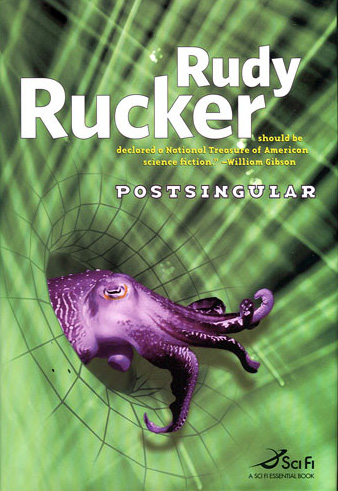
PostSingular
by Rudy Rucker
Published in 2007
Published by Tor

PostSingular opens with young engineering wizzes Jeff and Carlos attempting to launch a homemade rocket. Things go horribly wrong and Carlos is killed. This becomes the defining moment in young Jeff Luty's life. Do we now have our main protagonist? Will PostSingular be the story of heroic scientist Luty working to improve humanity while cherishing the memory of his lost childhood friend?

Nope. Jeff Luty grows up twisted and evil. He convinces the corrupt President Dick Dibbs of the USA to deliver to Mars some nanobots ('nants') that he's developed. They will swarm over the planet, disassemble it, and turn it into a gigantic computer for humanity's use. That's the version of his plan for public consumption, at least. What actually happens next is that the nants, fresh from eating Mars, start to devour the Earth and every living thing on it. Humanity is to be resurrected inside a virtual world under the benevolent rule of Dick Dibbs.

But Luty didn't count on his employee Ond Lutter, a genius troubled by something that almost resembles a conscience. He works out a code that will halt and reverse the onslaught of the nants. His autistic son Chu, whose mind bends in precisely the right ways, memorizes his dad's formula before the nants devour him. The resulting indigestion that his mind gives Luty's nants undoes all the damage that they have done. Humanity is saved. Happy ending.

Did I just summarize the entire plot of the book? Hahahahaha. That was just the first twenty pages. Things get much, much weirder when the main plot commences shortly afterwards.

PostSingular imagines a future where the astonishing happens, society adapts and becomes inured to it, and then the more astonishing happens. Repeat cycle.

For example, we see the introduction of a new technology that (among other things) allows you to see what's happening anywhere else in the world. Effortlessly. And yes, of course this includes watching your friends and neighbors have sex. (It can be blocked, but it takes industrial-strength technology that most people don't have access to.) But with the passage of time, as far as regular people are concerned it becomes the new normal. Most of the novel takes place after everybody's already used to it.

Bizarre piles on top of bizarre amid plenty of sharp narrative turns (the twentysomething hipster who's the closest thing the novel's got to a main protagonist doesn't appear until a third of the story has gone by) that Rucker somehow manages to avoid turning into a great big trainwreck. A fine stab at helping us appreciate the strangeness of life after the Singularity


The Constant Gardener
by John le Carre
Published in 2001
Published by Hodder & Stoughton
ISBN: 0-340-73337-3

And now for something completely different.

The Constant Gardener deals with murder and intrigue among the British diplomatic community in Kenya. It opens with the gruesome murder of Tessa Quayle, a prominent young British activist who had worked tirelessly on behalf of the poor and downtrodden of East Africa. Her husband Justin is a staid and proper functionary in the British embassy who had kept himself deliberately aloof from his wife's work. Now that she is dead, Justin takes an extended leave of absence to investigate her killing.

For whatever reason, from about the halfway point onward Justin Quayle was being played in my mind by Colin Firth, even though I know in official Movie Land he looks like Ralph Fiennes. I dunno, my mental image of the character just fits Colin Firth better.

I approve of John le Carre's ability to construct complex plots, although I will admit that I failed to ever get into the Cold War-era spy novels which he will certainly be best remembered for. I enjoyed The Tailor of Panama when I read it a couple of years ago, and The Constant Gardener is a similarly good standalone novel. I read it without knowing the plot ahead of time, which results in some enjoyable plot twists and turns (the initial viewpoint character, one Sandy Woodrow, turns out to not be the main protagonist but rather an antagonist, and a slimy one at that).

This is a very political novel and the bad guy is Big Pharma. I am personally far too ignorant to opine much about the ethics practiced by the big pharmaceutical companies without very likely making an ass of myself. In my last job I met a couple of people who worked at the main Taiwan office of one of the world's great pharmaceutical companies; more than one of them brought up ethical lapses that their competitors committed in order to make the point that their own company didn't do that sort of thing. Who knows. Maybe employees of every other pharma company would've told me the exact same thing.