Friday, February 11, 2011

How We Decide by Jonah Lehrer

I was a few chapters into How We Decide when I started thinking, "Haven't I read this before"?

A while back I read Malcolm Gladwell's anecdote-studded book Blink, whose thesis is that people often make far better decisions on the basis of intuition and "gut feeling" than when they carefully and consciously weigh the evidence. (And sometimes they don't -- Gladwell brings up Amadou Diallo as an example of somebody who died because men with guns followed their gut instincts when they shouldn't have.)

Jonah Lehrer, in the book's early chapters, discusses virtually the same idea. (Different anecdotes.) But his focus is different.

The fun-to-make-fun-of Gladwell made his name by packaging insights about people and society into easily digestible books and articles for the middlebrow masses. (I'm not making fun of the middlebrow masses. I belong to them.) He's a jack-of-all-trades. He writes about politics. He writes about culture. He spoke at TED about spaghetti sauce. And when he finally got lots of people pissed off at him, it was because of an article he wrote deriding Twitter's ability to make real change in the world.

Lehrer, on the other hand, specializes in minds and brains. He's got a solid background in neuroscience. He may never be famous enough to be mocked by The Onion, but he aims for the same middlebrow audience as Gladwell -- except you know that he knows his stuff. I read his blog.

Many of Lehrer's anecdotes are familiar to people who follow current developments in neuroscience and behavioral economics. My personal favorite: a university did a study where a sugar and caffeine-laden energy drink was available to students - for a price - just before the students did a battery of mental problems. One set of students bought the energy drinks at full retail price; the other set got them at a substantial discount. The exact same sugar and caffeine jolt both ways, but the students who paid full price did significantly better on the quiz than the ones who got the discount.

Another interesting finding: when test subjects (college students again) did a blind taste test of different varieties of strawberry jam, their preferences tallied closely with the preferences of the taste experts that Consumer Reports employs. That in itself is comforting news -- apparently the taste of these hifalutin' experts is not too different from that of unschooled hoi polloi like us. It got interesting, however, when another group of tasters were asked to provide reasons for why they preferred Brand A to Brand B when they assigned their ratings.

Analyzing taste sensations using language is difficult. I like food and I like going to restaurants, but I couldn't be a restaurant critic; I don't know how to talk about food. When these college students, largely unschooled in the science of flavors, were forced to justify their rankings using language, something happened. Jams that they ought to have liked plummeted. Jams that experts and ordinary college students alike had panned, were now among the most popular. These students were unable to put their instinctive reactions into language, so they reached, concocted explanations, and fooled themselves into thinking that their favorites were something other than what they were.

The final verdict? Minds are complicated. I liked one Amazon reviewer's impression: "Emotion trumps reason; or sometimes not; except when it does." It's hard to pin Lehrer down to a definite thesis statement that can be expressed in fifteen words or less, but in a way it's a source of pride. We're the species with really complex minds that contain an interplay of different forces. Uh-huh, that's us.

Wednesday, February 9, 2011

Cultural Difference: Political Cartooning

When I went to Kaohsiung last summer, I saw cartoon avatar pictures of Kaohsiung mayor Chen Chu everywhere I went.


I assumed it was all politicking for the upcoming mayoral elections (which Chen won easily). But I returned to Kaohsiung this month, over Chinese New Year, and Chen's avatars were if anything even more ubiquitous.


These posters are all over Kaohsiung. To celebrate the Year of the Rabbit, Chen appears to be wearing a rabbit head as a hat.


Portraying people as cartoon avatars is more common in East Asia than in the West, and it's not uncommon to see little cartoon figures of other prominent politicians on official city merchandise elsewhere in Taiwan. But I haven't seen any politician portrayed in cartoon form quite as much as Chen.


You can buy Chen merchandise in Formosa Boulevard MRT.

I'm not offended by any of this, or think it is improper. But I do think it illustrates a cultural difference between East and West. This would never fly in the United States. Sure, there are lots of souvenir shops in Washington DC where you can buy Barack Obama bobblehead dolls. But that's just the market filling a demand; it's not as if the White House is actively producing and promoting them.

Chen Chu's official title is Mayor. But Greater Kaohsiung includes a huge hinterland and is not part of any larger administrative unit, so Chen's position is really equivalent to a state governor in the United States. I'm trying to imagine the reaction if American state governments started distributing official signs, leaflets and brochures with adorable cartoon depictions of Andrew Cuomo or Rick Perry or Chris Christie or Deval Patrick.

I'm guessing the reactions would include quite a bit of mockery.

Offbeat Bride!

Our wedding has been featured on Offbeat Bride! With a lovely write-up by my wife Jenna, who was quite active in the OB community before the wedding (and after).

I read the Offbeat Brides book on the plane ride home for the wedding. It's awesome and fantastic to see us on the site.

Monday, February 7, 2011

Nonfiction 3: The Neuro Revolution by Zack Lynch

A few years back I read two books on futurism by Alvin Toffler, his 1970 classic Future Shock and his slightly less-known 1980 followup, The Third Wave.

It's easy to make fun of Toffler. Apparently the near-ubiquity of Future Shock makes it one of the most frequently discarded books, easy to find at garage sales and used bookstores.

If you read Toffler's books as a compendium of specific predictions about the future, you'd give him a grade of C minus, maybe C. C plus, tops. Like most futurists in the 1970s, Toffler was far too bullish about the future pace of space colonization. On the other hand, and again like most futurists in the 1970s, he knew something like the Internet was coming, but couldn't foresee either the speed with which it would become widespread, or how thoroughly it would reshape society.

But that would be missing the forest for the trees. Step back, look at the big picture, and you may need to squint at some chapters, and Toffler's books are a remarkably prescient look at the shift from the industrial age to postindustrial age.

Although it's a very different book, with a much narrower focus, I suspect that is approximately how Zack Lynch's The Neuro Revolution is going to hold up in a couple of decades.

The first in my "It's the Mind" trio of nonfiction books for February, The Neuro Revolution is Zack Lynch's discussion of the practical upshot of recent brain research, and what it's likely to mean in terms of technological and societal advances over the next few years and decades.

Lynch has spoken with several dozen of the foremost researchers into neuroscience, and makes extremely informed predictions about the likely future. He is not a totally starry-eyed optimist; he's not terribly bullish about the future of fMRI-based lie detection technology, for instance.

But he does make a lot of fairly confident statements about what will happen in the coming decades.

I'm sure that, fifty years from now, many of his predictions will seem overly optimistic. And others will have turned out to be far too conservative and cautious.

But his score doesn't really matter. Step back and see the forest rather than the trees, and Lynch is telling us that, barring apocalypse, what today's scientists are learning about the brain are going to have a huge practical impact on the world in 10, 20 and 30 years. Read this book and be less shocked by developments in a decade or three's time.

Tuesday, February 1, 2011

Novel 3: The Kite Runner by Khaled Hosseini

The Kite Runner is a popular book, a Very Important book, a best-selling book. So I will make fun of it. Be warned.

One movie critic, writing of the film adaptation of the book, writes that "every character harbors shades of gray". Really? Every character?

Hassan walks, talks, breathes, and lives Lawful Good. He doesn't have a shred of badness in him. He almost literally cannot tell a lie. Except for that one time, in the book's most critical scene, when he does tell a lie, because he is so fundamentally good it's all he can do.

Assef is almost a cartoon caricature of evil. I'm not just saying evil is encoded in his DNA; I'm saying that if scientists were to examine his nail clippings, they'd find evil extending all the way down to the subatomic level. The only reason I write that he's "almost" a cartoon caricature of evil is because I am well aware that even the more astonishing aspects of his character are not unrealistic.

I want to mock this book for the fact that the characters in it ought to be able to deduce that they're fictional characters by the amount of obvious symbolism that surrounds them. But to tell the truth, I can forgive that. The amount of symbolism, obvious (in retrospect) foreshadowing and other literary techniques on display is nothing new for me, as I've read quite a bit of modern South Asian literature.

Hassan and Assef do have one-directional moral compasses (although even that doesn't keep Hassan from becoming an interesting character) but that's entirely forgivable as they exist for the hugely gray viewpoint character, Amir, to interact with. Amir is the first-person narrator. Amir does some very bad things as a young boy, but he is very painfully aware that he is not a paragon of virtue. In the novel's second half, Amir is all grown up and he sets out to make things right, or as right as he can make things at this late date.

Overall, what do I think of the book? It's a page-turner. Compulsively readable. Even the scenes I read while peeking out from between my fingers.

Since I can't end this post without making fun of the book (as promised), I'll just say that I am impressed that on two separate occasions in the story's second half, Amir gets bad news according to the time-honored "Bad, Worse, Oh Crap" format. Examples of the format:

Bad - The factory that employed almost half of your town just shut down.
Worse - By "shut down" I mean "burned down with everyone inside".
Oh Crap - By "factory" I mean "unshielded nuclear reactor".

Bad - Your girlfriend breaks up with you for petty reasons and then immediately starts dating.
Worse - Your father.
Oh Crap - Who insists you call her "mom".

Identifying the two "bad news for Amir" scenes and assembling them into the "Bad, Worse, Oh Crap" format is left as an exercise for the reader.

Sunday, January 30, 2011

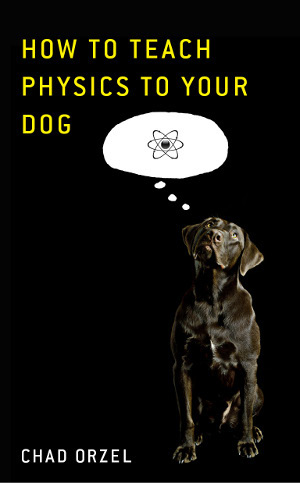
Nonfiction 2: How to Teach Physics to Your Dog by Chad Orzel

"Common sense is the collection of prejudices acquired by age eighteen." -- Albert Einstein

I'm a lifelong reader of popular science who nevertheless got mediocre grades in every formal science class I ever took. Bear that in mind.

It's fun to say that modern physics is "weird" and "strange" and "really complicated". But I suspect that's just our prejudices talking -- our experiences as human beings lead us to perceive the universe in ways that are really quite provincial.

E = mc^2 is hard to grasp because most of us have no experience converting energy into mass or vice versa, and we've got no intuitive concept of the speed of light.

If there is a fundamental objective basis of reality, it's going to look a lot more like quantum mechanics than anything Newton knew about. Yet, going by our instincts, we are blind to how reality actually operates. All we've ever experienced are enormous amalgamations of particles on the macro level where the truly weird properties of particles get canceled out. There's a bit of a tautology in that sentence, because the reason we humans think those properties are weird is because they get canceled out on the macro level.

I think if we get kids used to how quantum mechanics works at a very young age, they'll grow up thinking it's normal and natural. To make it seem more natural to human brains, this will of course involve new grammar -- we need at least one new verb tense, probably more. We ought to come up with new vocabulary too. "Wavefunction" is an awkward word coined by adults who could only conceive of this aspect of reality through equally awkward thought experiments. We need some new, monosyllabic nouns and verbs.

(I'm kidding, inasmuch as I don't actually think there's a lot to be gained by raising kids without our macroscopic blinders. At least, I think I'm kidding. This parenthetical aside might sound like too-cautious backpedaling in a few decades.)

I liked Orzel's book a lot, particularly his implication that dogs find quantum mechanics easier to grasp because they don't have humans' common-sense blinders. Orzel really does make these concepts relatively easy for non-specialists to understand, and he does it without dumbing down. That's right -- the book's got a talking dog, and quantum mechanics isn't dumbed down. Really.

I'd been softened up by previous pop-sci books I'd read on the subject -- I like Leon Lederman's The God Particle, which isn't primarily about quantum mechanics, but as it's about subatomic particles, it can hardly avoid dealing with it. There's also science fiction. Greg Egan's awesome novel Quarantine can be read as a satire on the Copenhagen interpretation, imagining a universe where it's actually how reality works, and technology is developed that exploits it on a macro level.

(The Copenhagen interpretation is the idea that -- and I'm assuming everyone reading this has heard of Schrodinger's Cat -- the cat is simultaneously alive and dead until a conscious observer actually looks, in which case one of the two blinks out of existence and the other becomes fully real. Collapse of the wavefunction, they call it. As I understand it, most scientists do not believe this is how reality actually operates. Instead, they believe things that are arguably stranger.)

There are chapters I want to re-read again soon, so that I can get a better grasp on them. Ideally, I'll have a good enough grasp of what's going on so that I can read articles like this one without feeling stupid.

Thursday, January 27, 2011

My First 2012 Election Prediction

Battles over who gets to be the Republican nominee for President may be full of sound and fury, telegenic sound bites and memorable personal attacks. But every election year of my life, and well over a decade before that, they have ended the same way.

Election after election, the nominee has been the guy who was best-positioned to win at the beginning of the calendar year before the election. Before anyone declared their candidacy. Before all the sniping and scuffling between candidates began.

George W. Bush was widely seen as the front-runner (though I'm still not clear why) at the start of 1999. Bob Dole was the already the guy to beat at the beginning of 1995. It was generally assumed that Vice President Bush would be his party's nominee when 1987 began. Ronald Reagan was the front-runner for the 1980 nomination before 1979 even began. Elected or not, Gerald Ford was the incumbent and thus clearly the most likely pick for the 1976 nomination. Richard Nixon was seen as the likeliest 1968 nominee even in early 1967.

If there's an exception to this, it's John McCain in 2008, but I'm not sure he counts. From what I recall, at the start of 2007 McCain was widely expected to be the eventual nominee. Then, over the course of that year, his star faded as pundits decided he was running a lackluster campaign, and Romney and Giuliani and Fred Thompson rose in prominence. When the primary season actually started and McCain vanquished all his challengers within a month, it looked like he was coming from behind, but actually he was reclaiming his former spot.

If this pattern holds, the 2012 nominee will be the most boringly obvious of the current contenders. Half of the Republican Party is terrified of Palin. Huckabee is well-liked, but he's not taken seriously. Gingrich is taken seriously, but he's not well-liked. The other candidates will never be able to shake the perception that they're second-tier.

Obama vs. Mitt Romney in November 2012. It may be boring, but it's my prediction.

Wednesday, January 26, 2011

Novel 2: The Eyre Affair by Jasper Fforde

Boy, I need to get up to speed on my British drollery. Here I sit, having finished The Eyre Affair and feeling very comfortable with its dry British surrealistic wit, but the only thing I can find to compare it to is Douglas Adams' Dirk Gently books. I mean, nothing against Dirk Gently, but everyone knows Adams. Well, the next time I read a very, very British bit of drollery, at least now I can compare it to Jasper Fforde.

The universe of The Eyre Affair, the first of (so far) five Thursday Next books, plays very well to my sensibilities. The year is 1985, England is enmeshed in a thirteen-decade-long quagmire in the Crimea, the People's Republic of Wales sits right next door, dirigibles are the preeminent mode of arial transportation, genetically re-created dodos and great auks are popular pets, and classic literature somehow occupies a far higher place in pop culture consciousness than movies and TV. The scene where Richard III is performed for a rowdy crowd who treat it with the same appreciation that greets Rocky Horror in our universe ought to warm the cockles of all Shakespeare-loving hearts.

For her first book, SpecOps operative and main protagonist Thursday Next must deal with criminal schemes that revolve around the following basic facts about how this universe operates:

1) If you alter a text, the alterations will instantaneously spread to every text that was copied from that one. So it's easy to see why original literary manuscripts are guarded against criminal mischief.

2) The division between "real life" and works of fiction is a permeable one. People from "real life" regularly go vacationing in classic works of 19th-century literature; similarly, fictional characters (and devices) can be brought into the "real world".

Additionally, fictional characters are fully conscious of being fictional. Rochester from Jane Eyre delivers a particularly moving account of how life as a character is in many ways superior to life as a real person.

Which brings me to my unfortunate confession: I've never read Jane Eyre. I suppose Fforde's book is perfectly comprehensible even if you're totally ignorant of the original story, but I went to Wikipedia to catch up on what I'd missed.

There are several marvelous little details that went into this world but never actually become directly relevant to the story. The Eyre Affair was published in 2001 but set in 1985; that date seems arbitrary, as it could just as easily have been set in 1970 or 2015. Vampires and werewolves inhabit this world, but they're limited to a subplot that only tangentially touches on the main plot. There are hints that England was once occupied by Nazis, but nothing is ever made of this. When I read the sequels, I'll be very interested to see if this is groundwork being laid for future plot developments.

Wednesday, January 19, 2011

The Monkeys You Ordered

Some humor expert needs to come along and explain how and why Literal New Yorker Captions -- in which New Yorker cartoons have been re-captioned with stunningly mundane literalness -- had me giggling helplessly until I'd read every one.

Monday, January 17, 2011

The Public Domain: Enclosing the Commons of the Mind by James Boyle


Until around 2007, it never really occurred to me that copyright law was a hot-button issue for more than a handful of people. Oh, I recall reading Spider Robinson's "Melancholy Elephants" years ago, and its "perpetual copyright is bad" lesson stuck with me. But I can't say the issue really entered the forefront of my mind during my adult years.


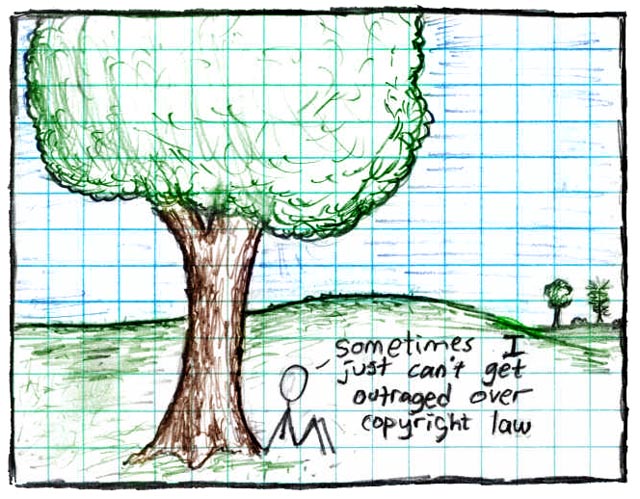
Xkcd cartoon #14, one of the earliest available online. I was going to include it in this post even before I realized Boyle himself mentioned the cartoon on page 245.

In 2007, I began reading Boing Boing religiously; its editors feel quite strongly about abuses of copyright and patent law. That same year I discovered short fiction podcasts, which introduced me to the idea of Creative Commons licenses. Slowly but surely, the concepts surrounding the issue wormed their way into my head.

Boyle's book The Public Domain is an excellent introduction to the issue, one which I'm not going to destroy by badly paraphrasing here. It's true that Boyle doesn't try to be unbiased; his own point of view is clear. But I get the feeling that people who fundamentally disagree with Boyle will want to downplay the contentiousness of the issue ("why, who would deny that artists have a right to keep their work out of the nasty old public domain forever and ever and ever?"), and as such are less likely to write books about the subject.

What sticks with me is Boyle's last chapter, where he speculates that tussles over intellectual property in the last decade bear a similarity to the environmental movement in the 1950s. In that decade there were scattered groups of individuals in the world with strong opinions whom we would label "environmentalists" today, but there was no public awareness of an "environmental movement". So it has been, so far, with proponents of an intellectual commons.

Friday, January 14, 2011

Novel 1: An Equal Music by Vikram Seth

1. Vikram Seth.

An Equal Music was the first work of Sethian fiction I've read, although last year I read his very nice From Heaven Lake, a travelogue he wrote as a young student in the early 1980s journeying through western China.

I am aware that out there lurks an extremely long and very well-known Seth novel called A Suitable Boy. My wife says it's excellent.

I'm ready to start hunting for it now that I've had a taste of Seth's fiction. As my wife has observed, there really are no absolute good guys or bad guys in An Equal Music, only beautifully drawn human beings with their own motives. I like it when I can read fiction purely for the pleasure of watching the characters interact.

2. Classical music.

My relationship to classical music has been something of a tangential one. I played the trombone in various school bands and music classes in high school and university, including a single semester in university orchestra. In addition, I played the piano for a few years as a kid, as well as (very briefly) the violin. If I took up the piano or the trombone again now, and began practicing again, and kept at it for a good long time, I think I could use brute force to bring myself up to a semi-respectable level of skill. But I've proven to myself that I don't have any special natural talent for music.

I belong to that segment of the public that, as Benjamin Zander says in one of the most deservedly popular TED talks of all time, "doesn't mind" classical music.


In short, I like classical music well enough, and I have some Bach and Beethoven on my iPod, but to tell the truth there are few classical pieces that, if I heard them, I could correctly identify by name.

That's too bad.

3. The plot.

I'm not going to talk about the plot. What is this, a junior high book report?

Tuesday, January 4, 2011

New Year's Resolution

In 2011, I'm going to read 40 nonfiction books and 40 novels. And I'll write about them here as I finish them.

It's not my only 2011 goal -- I've got other intellectual and self-improvement and professional-type New Year's resolutions. But let's not worry about them right now. That's partly because I see no real benefit to blogging about them, and partly because as Derek Sivers pointed out, it's generally a bad idea to tell the world about your laudable new goals for yourself.

I have no plan, no set reading list. My 40 nonfiction books and 40 novels will consist, in part, of my working my way through the dozens of books on our shelves that I haven't read yet. They're sitting there now, waiting for that as-yet-undetermined future date when we move, when I find myself wondering which unread books I want to ship overseas and which I want to sell or donate, unused. And every time I visit a used bookstore, my impulse buys exacerbate the problem.

When I say 40 nonfiction books and 40 novels, I mean 80 physical, bound paper, full-length books. I'm a big fan of long-form journalism, and lately my iPod Touch has made it pretty easy for me to polish off several newspaper or magazine articles while I'm riding the bus or on the subway. (Here is where I rave again about InstaPaper, and web sites like Longform.org and Give Me Something To Read.) I'm also a big fan of short stories, particularly SF/Fantasy/Horror, and I follow several podcasts that feed my addiction. They don't count. I plan to keep consuming shorter content alongside my 80 full-length books.

I see this as benefiting me in two ways. One is organizing my free time. I'm a naturally voracious reader. But I'm also lazy, and my time management skills are terrible. (And by "terrible" I mean "nonexistent".) During times of my adult life when I've had a lot of free time, I haven't gotten any more done than at times when I've been extraordinarily busy. In fact, I'd go so far as to say that the more free time I have, the less I get done. I'm the sort of person who can take a free evening, spend it on FailBook and reading through various webcomic archives, and then wonder where the time went.

The other way this will be good for me is encouraging me to write a halfway intelligent-sounding reaction to each book. How often is it that I want to write something intelligent, but I end up just sitting in front of my computer with an expression of pure stupidity on my face, unable to think of anything more eloquent than, "Me liked it. It was good. Me mighty reader. Leave hunting mammoth to others." If I can't say anything genuine and intelligent, I'll say something cheeky or snarky and hope to God that I don't sound like an idiot. Or I'll write about what I remember of a Star Trek episode I watched when I was nine, and hope that somebody, somehow, thinks it makes perfect sense in relation to the book on modern Indian culture that I just finished.

Maybe that will help me attain one of the great goals of the decade that's totally over now: becoming a better blogger.