Thursday, January 27, 2011

My First 2012 Election Prediction

Battles over who gets to be the Republican nominee for President may be full of sound and fury, telegenic sound bites and memorable personal attacks. But every election year of my life, and well over a decade before that, they have ended the same way.

Election after election, the nominee has been the guy who was best-positioned to win at the beginning of the calendar year before the election. Before anyone declared their candidacy. Before all the sniping and scuffling between candidates began.

George W. Bush was widely seen as the front-runner (though I'm still not clear why) at the start of 1999. Bob Dole was the already the guy to beat at the beginning of 1995. It was generally assumed that Vice President Bush would be his party's nominee when 1987 began. Ronald Reagan was the front-runner for the 1980 nomination before 1979 even began. Elected or not, Gerald Ford was the incumbent and thus clearly the most likely pick for the 1976 nomination. Richard Nixon was seen as the likeliest 1968 nominee even in early 1967.

If there's an exception to this, it's John McCain in 2008, but I'm not sure he counts. From what I recall, at the start of 2007 McCain was widely expected to be the eventual nominee. Then, over the course of that year, his star faded as pundits decided he was running a lackluster campaign, and Romney and Giuliani and Fred Thompson rose in prominence. When the primary season actually started and McCain vanquished all his challengers within a month, it looked like he was coming from behind, but actually he was reclaiming his former spot.

If this pattern holds, the 2012 nominee will be the most boringly obvious of the current contenders. Half of the Republican Party is terrified of Palin. Huckabee is well-liked, but he's not taken seriously. Gingrich is taken seriously, but he's not well-liked. The other candidates will never be able to shake the perception that they're second-tier.

Obama vs. Mitt Romney in November 2012. It may be boring, but it's my prediction.

Wednesday, January 26, 2011

Novel 2: The Eyre Affair by Jasper Fforde

Boy, I need to get up to speed on my British drollery. Here I sit, having finished The Eyre Affair and feeling very comfortable with its dry British surrealistic wit, but the only thing I can find to compare it to is Douglas Adams' Dirk Gently books. I mean, nothing against Dirk Gently, but everyone knows Adams. Well, the next time I read a very, very British bit of drollery, at least now I can compare it to Jasper Fforde.

The universe of The Eyre Affair, the first of (so far) five Thursday Next books, plays very well to my sensibilities. The year is 1985, England is enmeshed in a thirteen-decade-long quagmire in the Crimea, the People's Republic of Wales sits right next door, dirigibles are the preeminent mode of arial transportation, genetically re-created dodos and great auks are popular pets, and classic literature somehow occupies a far higher place in pop culture consciousness than movies and TV. The scene where Richard III is performed for a rowdy crowd who treat it with the same appreciation that greets Rocky Horror in our universe ought to warm the cockles of all Shakespeare-loving hearts.

For her first book, SpecOps operative and main protagonist Thursday Next must deal with criminal schemes that revolve around the following basic facts about how this universe operates:

1) If you alter a text, the alterations will instantaneously spread to every text that was copied from that one. So it's easy to see why original literary manuscripts are guarded against criminal mischief.

2) The division between "real life" and works of fiction is a permeable one. People from "real life" regularly go vacationing in classic works of 19th-century literature; similarly, fictional characters (and devices) can be brought into the "real world".

Additionally, fictional characters are fully conscious of being fictional. Rochester from Jane Eyre delivers a particularly moving account of how life as a character is in many ways superior to life as a real person.

Which brings me to my unfortunate confession: I've never read Jane Eyre. I suppose Fforde's book is perfectly comprehensible even if you're totally ignorant of the original story, but I went to Wikipedia to catch up on what I'd missed.

There are several marvelous little details that went into this world but never actually become directly relevant to the story. The Eyre Affair was published in 2001 but set in 1985; that date seems arbitrary, as it could just as easily have been set in 1970 or 2015. Vampires and werewolves inhabit this world, but they're limited to a subplot that only tangentially touches on the main plot. There are hints that England was once occupied by Nazis, but nothing is ever made of this. When I read the sequels, I'll be very interested to see if this is groundwork being laid for future plot developments.

Wednesday, January 19, 2011

The Monkeys You Ordered

Some humor expert needs to come along and explain how and why Literal New Yorker Captions -- in which New Yorker cartoons have been re-captioned with stunningly mundane literalness -- had me giggling helplessly until I'd read every one.

Monday, January 17, 2011

The Public Domain: Enclosing the Commons of the Mind by James Boyle


Until around 2007, it never really occurred to me that copyright law was a hot-button issue for more than a handful of people. Oh, I recall reading Spider Robinson's "Melancholy Elephants" years ago, and its "perpetual copyright is bad" lesson stuck with me. But I can't say the issue really entered the forefront of my mind during my adult years.


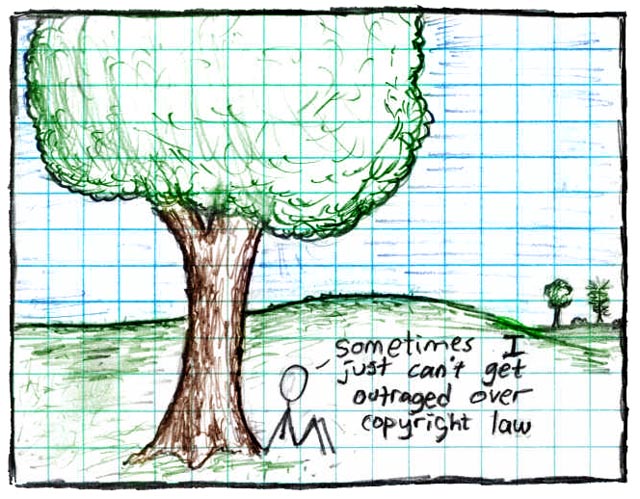
Xkcd cartoon #14, one of the earliest available online. I was going to include it in this post even before I realized Boyle himself mentioned the cartoon on page 245.

In 2007, I began reading Boing Boing religiously; its editors feel quite strongly about abuses of copyright and patent law. That same year I discovered short fiction podcasts, which introduced me to the idea of Creative Commons licenses. Slowly but surely, the concepts surrounding the issue wormed their way into my head.

Boyle's book The Public Domain is an excellent introduction to the issue, one which I'm not going to destroy by badly paraphrasing here. It's true that Boyle doesn't try to be unbiased; his own point of view is clear. But I get the feeling that people who fundamentally disagree with Boyle will want to downplay the contentiousness of the issue ("why, who would deny that artists have a right to keep their work out of the nasty old public domain forever and ever and ever?"), and as such are less likely to write books about the subject.

What sticks with me is Boyle's last chapter, where he speculates that tussles over intellectual property in the last decade bear a similarity to the environmental movement in the 1950s. In that decade there were scattered groups of individuals in the world with strong opinions whom we would label "environmentalists" today, but there was no public awareness of an "environmental movement". So it has been, so far, with proponents of an intellectual commons.

Friday, January 14, 2011

Novel 1: An Equal Music by Vikram Seth

1. Vikram Seth.

An Equal Music was the first work of Sethian fiction I've read, although last year I read his very nice From Heaven Lake, a travelogue he wrote as a young student in the early 1980s journeying through western China.

I am aware that out there lurks an extremely long and very well-known Seth novel called A Suitable Boy. My wife says it's excellent.

I'm ready to start hunting for it now that I've had a taste of Seth's fiction. As my wife has observed, there really are no absolute good guys or bad guys in An Equal Music, only beautifully drawn human beings with their own motives. I like it when I can read fiction purely for the pleasure of watching the characters interact.

2. Classical music.

My relationship to classical music has been something of a tangential one. I played the trombone in various school bands and music classes in high school and university, including a single semester in university orchestra. In addition, I played the piano for a few years as a kid, as well as (very briefly) the violin. If I took up the piano or the trombone again now, and began practicing again, and kept at it for a good long time, I think I could use brute force to bring myself up to a semi-respectable level of skill. But I've proven to myself that I don't have any special natural talent for music.

I belong to that segment of the public that, as Benjamin Zander says in one of the most deservedly popular TED talks of all time, "doesn't mind" classical music.


In short, I like classical music well enough, and I have some Bach and Beethoven on my iPod, but to tell the truth there are few classical pieces that, if I heard them, I could correctly identify by name.

That's too bad.

3. The plot.

I'm not going to talk about the plot. What is this, a junior high book report?

Tuesday, January 4, 2011

New Year's Resolution

In 2011, I'm going to read 40 nonfiction books and 40 novels. And I'll write about them here as I finish them.

It's not my only 2011 goal -- I've got other intellectual and self-improvement and professional-type New Year's resolutions. But let's not worry about them right now. That's partly because I see no real benefit to blogging about them, and partly because as Derek Sivers pointed out, it's generally a bad idea to tell the world about your laudable new goals for yourself.

I have no plan, no set reading list. My 40 nonfiction books and 40 novels will consist, in part, of my working my way through the dozens of books on our shelves that I haven't read yet. They're sitting there now, waiting for that as-yet-undetermined future date when we move, when I find myself wondering which unread books I want to ship overseas and which I want to sell or donate, unused. And every time I visit a used bookstore, my impulse buys exacerbate the problem.

When I say 40 nonfiction books and 40 novels, I mean 80 physical, bound paper, full-length books. I'm a big fan of long-form journalism, and lately my iPod Touch has made it pretty easy for me to polish off several newspaper or magazine articles while I'm riding the bus or on the subway. (Here is where I rave again about InstaPaper, and web sites like Longform.org and Give Me Something To Read.) I'm also a big fan of short stories, particularly SF/Fantasy/Horror, and I follow several podcasts that feed my addiction. They don't count. I plan to keep consuming shorter content alongside my 80 full-length books.

I see this as benefiting me in two ways. One is organizing my free time. I'm a naturally voracious reader. But I'm also lazy, and my time management skills are terrible. (And by "terrible" I mean "nonexistent".) During times of my adult life when I've had a lot of free time, I haven't gotten any more done than at times when I've been extraordinarily busy. In fact, I'd go so far as to say that the more free time I have, the less I get done. I'm the sort of person who can take a free evening, spend it on FailBook and reading through various webcomic archives, and then wonder where the time went.

The other way this will be good for me is encouraging me to write a halfway intelligent-sounding reaction to each book. How often is it that I want to write something intelligent, but I end up just sitting in front of my computer with an expression of pure stupidity on my face, unable to think of anything more eloquent than, "Me liked it. It was good. Me mighty reader. Leave hunting mammoth to others." If I can't say anything genuine and intelligent, I'll say something cheeky or snarky and hope to God that I don't sound like an idiot. Or I'll write about what I remember of a Star Trek episode I watched when I was nine, and hope that somebody, somehow, thinks it makes perfect sense in relation to the book on modern Indian culture that I just finished.

Maybe that will help me attain one of the great goals of the decade that's totally over now: becoming a better blogger.

Wednesday, December 8, 2010

Technology and Me

I have a bad habit: my attention wanders when I'm reading. It's especially a problem if I'm reading off a computer screen, and that computer happens to be connected to the Internet. Hello, Source of All Distractions! This is the main reason why I dislike reading long articles or stories off a computer, and I couldn't even begin to imagine reading a novel that way. In the past, when there was a nice long chunk of Internet-based writing I wanted to read, I would go so far as to print it out so that I could peruse it later, when the distraction of the whole world wasn't just a mouse-click away.

Another bad habit I have goes back to the days before I knew the Internet existed. I tend to get impatient when I'm reading, even if it's a piece of fiction that's really sunk its barbs into me. My eyes insist on skipping ahead a few paragraphs; my fingers insist on flipping ahead a few pages, just to get a glimpse of what's going to happen. It's incredibly distracting.

Technology to the rescue! I own an iPod Touch now. It's got WiFi but not 3G/4G; its screen is big enough to display one or two paragraphs of text but not more. I think it may be my saviour.

Even when I'm in a place with free wi-fi, the Touch interface (the same as the iPhone interface) makes it awkward to have several windows open at once, which I view as a feature, not a bug. It reduces the temptation to go check Facebook when in the middle of an eight-thousand-word article. And the screen size focuses my attention on the current paragraph or two of text.

I've already downloaded the Instapaper app (well worth the five bucks) which saves online articles locally on your device. Only caveats are that it sometimes does minor odd things to the formatting (for example, section headings might become indistinguishable from ordinary text), and occasionally I've accidentally saved only a fragment of a long article rather than the entire thing (you gotta be careful about sites breaking an article across several pages for the supposed convenience of the reader). Otherwise it's been a fine little investment for me. Instapaper plus Longreads equals Good.

Now to await my check from Instapaper in return for shilling their product.

Wednesday, December 1, 2010

The Dust Has Cleared


So what actually happened in those Taiwan municipal elections?

BEFORE THE ELECTION, I believed Su Tseng-chang had a real shot of knocking off Taipei mayor Hau Lung-bin, and in any event the race would be close.

WRONG. Hau demolished Su by 12 percentage points. There are rumors that Su's unexpectedly large loss has ended any realistic shot he may have at winning the DPP presidential nomination in 2012, though I think it's a bit too early to tell.

BEFORE THE ELECTION, I thought the KMT would achieve a better performance in Sinbei than in Taipei. I thought Tsai Ing-wen could only hope to win election if she rode a nationwide DPP wave.

MOSTLY WRONG. Tsai lost, but she made it close, winning a greater percentage of the vote than Su.

BEFORE THE ELECTION, I thought the Taichung, Tainan, and Kaohsiung mayoral races would not even be close, with the KMT winning easily in Taichung and the DPP taking the other two.

PARTLY WRONG. Tainan and Kaohsiung voted pretty much the way everyone expected them to, but Taichung mayor Jason Hu got a real scare on Election Day when his opponent, Su Jia-chyuan, came very close to unseating him. Now Su's getting a lot of praise in the DPP and people are talking about him as a real 2012 presidential contender.

The day before the election, people told me they expected something surprising to happen on Election Eve. Sure enough, that evening a prominent KMT politician (not a candidate for anything, but a famous face), Sean Lien, was shot and wounded in an assassination attempt in Yonghe, not far as the crow flies from our apartment. Lots of famous and non-famous people have theorized that the KMT got a good deal of sympathy vote as a result, which may well have denied Tsai Ing-wen and Su Jia-chyuan victories in their respective cities.

As a result, of course, we're already hearing the conspiracy theories.

The sad thing is, unsuccessful attempts to assassinate politicians the day before elections, causing people to argue over whether it skewed the results, is something of a tradition in Taiwan. Hopefully it won't happen in 2012.

Wednesday, November 24, 2010

Taiwan Election 2010!


I have Taiwan Election 2010 Pictures!


Also see Jenna's election coverage here.

Elections are Saturday, November 27 for the mayorships of Taiwan's five biggest municipalities, as well as a host of lesser offices. Taipei is now absolutely covered with signs for various candidates, and the streets are full of campaign workers distributing flyers to passers-by as if to say, "Here, you throw this away".


Little cartoon avatars of the candidate are pretty common, as you can see with Popeye here. If it's common in Taipei it seems to be even more common in Kaohsiung, which is full of cute little Chen Chu cartoons.

In Kaohsiung, Tainan, and Taichung the mayoral races are not expected to be especially close. DPP candidates are generally expected to win election in Kaohsiung and Tainan, and the KMT mayor is expected to be re-elected in Taichung.

That leaves Taipei and Sinbei, the latter of which is not, properly speaking, a "city", but rather the suburbs of Taipei packaged together and newly incorporated to form the new largest municipality in Taiwan.


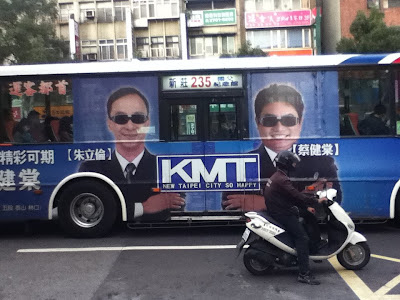
The incumbent mayor of Taipei is Hau Long-bin, seen here in improbable clothing on the side of a Taipei City bus (if I'm reading the Chinese correctly, it's about Hau's tireless efforts to prevent flooding).


Here's Hau with a local City Council candidate. It's common on election posters for local, lesser-known candidates to pose with a much more prominent member of the same party.


Hau's opponent is Su Tseng-chang of the DPP. It's universally believed that Su's real goal is to be elected president (he unsuccessfully campaigned for the DPP's presidential nomination in 2008), and many go so far as to say he entered the Taipei mayoral race expecting to lose, hoping the publicity and campaign organization would give him a stronger platform from which to challenge Ma in 2012.

If that's so, it looks likely to backfire for him. A year ago, nobody thought Hau's numbers would be as weak as they are now. Su looks very likely to actually topple Hau, which will put him in the position of either having to scuttle his 2012 ambitions or going back on his promise to serve out his term if elected. (I'm not certain, but I believe he'd be legally obligated to resign as mayor if he ran for president.)


Local candidate Zhou Ni-an's truck there has lots of political imagery. That's not only Su Tseng-chang in the right background, but former president Lee Teng-hui on the left. He's the former KMT president who has since turned his back on his former party and actively campaigns against it every time election season rolls around. On the right there's a pun, which is pretty common on election posters; it says something like "Wishing you well," which sounds like Zhou's name.

I don't live in the not-yet-existing Sinbei City, but as it comprises most of Taipei's suburbs, plenty of Taipei city buses whose routes are partly in Sinbei are festooned with Sinbei campaign advertising.


On the left is Sinbei mayoral candidate Chu Li-luan; on the right is a local candidate for, I believe, city councilor. They're trying so hard to convince us that they're cool, with their "MiB" getup.

Chu, universally referred to in the English-language media by his Anglo name Eric, is considered the KMT young handsome rising star right now. If you asked Taiwanese people to predict the likely KMT presidential nominee in 2016, you'd hear Chu's name more than any other.


Tsai Ing-wen is the chairwoman of the DPP and Chu's opponent for mayor of Sinbei. She's also generally thought to be planning to challenge Ma in the 2012 election, which means the DPP will be in an interesting position if Tsai and Su both win their respective elections.

I'll probably make another election-themed post in a couple of days once we know more of the fate of Mr. Hau, Mr. Su, Mr. Chu, and Ms. Tsai.

Monday, November 22, 2010

The DC Metro

From the Washington Post: Commuter describes harrowing climb on Metro escalator, as he found himself climbing up a stopped escalator as the only way to exit Tenleytown station:

Murphy, 51, arrived on a train from his job downtown with the American Sociological Association about 4:10 p.m. and found that two of the three escalators at the Tenleytown exit were out of service. The only functioning escalator was carrying customers down.

A bit miffed but not surprised, Murphy, together with at least four other people, selected his route - the closest halted escalator - and started trudging up the long metal path. There were no warning signs or barricades at the bottom, and as a result they decided not to rope together for the climb.

Huffing and puffing, they neared the top, Murphy recalled, only to be horrified at the obstacle that lay ahead.

"Imagine our shock to find a giant HOLE where several steps should have been!" Murphy wrote in an e-mail.
It gets better:

Once over the crevasse, the group huddled, catching their breath, and a Metro employee approached.

Murphy and other customers told her of their ordeal, but she was cold and unsympathetic, he said. "All she really said is, 'You shouldn't be there.' She said it over and over," Murphy said. The businessman also tried to get through to her, but the Metro employee appeared unfazed. "She had her line and she kept repeating it," Murphy said.

I've spent about six years of my life, total, living car-less in DC and taking the Metro on a near-daily basis. Sadly, there's nothing in this article that I find difficult to believe.

To leave the station, one either had to take a cramped elevator (which might well have been out of service) or climb up a stopped escalator? Unfortunately, that's just about par for the course. Taking the Metro regularly gave me countless chances to thank Fate I was healthy and able-bodied.

The stalled escalator turned out to have a great big HOLE in it that was invisible from the lower level? That never happened to me, but really I can't say I'm terribly surprised.

But, for me, the real gem of this story, the icing on the cake, the final indignity for these commuters, was the attitude of the station staff after the commuters had nearly gotten themselves killed trying to get the hell out of the station.

I could deal better with a subway system that suffered from frequent delays, broken escalators, broken elevators, and various other annoyances if it were staffed by personnel who displayed even the slightest understanding that the people who rode their trains were actual human beings.

I feel like sympathy and empathy are sucked out of Metro employees as an administrative policy. My mother says she was in a DC Metro station once and she saw a bunch of tourists ask a janitor for directions. The janitor was friendly and he helped them out, only to then be chastised by an actual Metro employee. Apparently, as a janitor, he was not supposed to interact with the Metro riders.

My own favorite Metro employee experience came when I lived on Columbia Pike. One cold evening I was waiting for a bus at the bus stop adjacent to Pentagon station. A woman asked an employee about the bus schedules. She sounded a bit peeved; apparently she'd been waiting for over half an hour for a bus up Columbia Pike. The employee spoke to her in a soothing voice. Clearly he knew how to deal with an irate customer. In a tone that said he knew she was exaggerating but he understood her feelings anyway, he reminded her that buses up Columbia Pike departed every fifteen minutes, and this evening was no exception.

I'd been there for longer than the woman. I'd been there for about forty-five minutes. THERE HADN'T BEEN ANY GODDAMNED BUS.

The woman didn't pursue the matter any further. I still regret that I didn't confront the station employee; chalk it up to my own non-confrontational nature.

Wednesday, November 3, 2010

Republican Party Loses in 2010 Elections

WASHINGTON - Democrats expressed joy and relief this morning as they emerged from their bunkers in the nation's capital to realize that the long-feared Republican offensive of November 2, 2010 had failed completely.

The numbers hinted at the full extent of the Democrats' victory: in the 435-member House, it was estimated that possibly as many as 195 Democrats, enough to fill between one third and one half of the chamber, were still in power. Even more impressively, subsequent investigations revealed that all of the several dozen Democrats who had held seats in Congress, but were dislodged from it on November 2, were still alive.

The party confirmed late Wednesday morning that not a single Democrat had perished. Tears of relief were observed among party faithful who had been terrified by Republican promises to exterminate Congressional Democrats and sterilize their children, bringing an end to each of the 255 individual genetic lineages among the Democrats of the 111th House.

Efforts to name Rand Paul as Most Honored Philosopher-Mentor failed; Mr. Paul found himself unable to secure anything more than a Senate seat. Similarly, Pat Toomey was unable to install himself as His Excellency the Keeper of the Grand Treasury, which would have entitled him to stroll about central Washington wearing a suit of pure woven gold. Instead, he will also have to content himself with a simple Senate seat.

Threats to catapult Russ Feingold into the searing heat of the Sun came to nought, as did pledges to reduce Blanche Lincoln to a slowly expanding cloud of elementary particles in interstellar space. Both politicians were, in fact, still alive as of Wednesday morning.

Republican Chairman Michael Steele gamely tried to put a positive spin on his party's losses, but general opinion was that his message was diluted as a result of the the scene that immediately followed, in which furious Tea Party chief Sarah Palin hurled henchwomen Christine O'Donnell and Sharron Angle into a shark tank. They were both torn to shreds in a bloody feeding frenzy as punishment for their failures. Another minion, Joe Miller, is confined to a tiny metal cage in a remote part of Alaska. Senior officials are said to be carefully reviewing his recent performance; if they judge him a failure, he will be fed to polar bears.

President Barack Obama emerged from his bunker seventeen miles below Washington DC at about nine o'clock Wednesday morning. "We ceded some ground," he said, blinking in the sunlight as he addressed reporters. "Our party does not control as many seats in Congress as it did last week. But in the future, when times may be dark for our party, we will look back on November 2, 2010. And we will remember it fondly as the day when our opponents, the Republicans, sought a glorious victory but instead met only spectacular failure."

Tuesday, November 2, 2010

Civility: Some Rambling Thoughts


So I’m at a loss about what we’re supposed to do in the world according to Jon Stewart. Hey, all you people working for gay and lesbian equality, all you women asking for equal pay, all you workers trying to unionize, all you peaceniks trying to end the war in Afghanistan, all you nurses and doctors and clinic workers trying to maintain reproductive freedom and keep women alive, all you teachers trying to teach science and history without censorship, all you citizens trying to build a rational health care policy, all you scientists and doctors who want our country to progress in medical research, all you damned secularists who want to keep religion out of our schools and government, hey, hey, HEY, you! Tone it down. Quit making such a fuss. You’re too loud. Shush. You’re as crazy as the teabaggers if you think your principles are worth fighting for.
That's Pharyngula on the message of the Stewart/Colbert rally. Zunguzungu has similar thoughts here and here.

I agree ninety percent, but I think I half-disagree as well. That implies a total of a hundred and forty percent. I'm weird like that.

What am I trying to say? Well, let's look at the Tea Party brand. I don't agree with what the Tea Party stands for, but I don't think it's necessarily racist at its heart either. But it's impossible to deny a lot of loud people in the movement say a lot of really, truly racist things.

In the past I've wondered why the most prominent promoters of the Tea Party brand haven't loudly spoken out against this kind of moronic tomfoolery. Wouldn't that be leadership? But then (this is going to sound a little conspiracy theory-esque) I realized to just what extent the Tea Party brand was promoting the idea among Tea Partiers that they're looked down upon by elitist snobs. Tea Partiers are condescended to. Not understood. Not listened to. Oppressed. So it makes sense to get liberals to believe that Tea Partiers = Bigots and Morons. The better to encourage Tea Partiers to go into defensive formation and support Tea Party candidates all the harder.

If I had to summarize that on a bumper sticker or protest sign:


If you think your political opponents condescend to you, you'll enter a defensive formation. Defensive formations cause echo chambers. Echo chambers cause whacked-out beliefs. I wonder if climate change denialism would be so popular in the United States if not for the fact that it's big dumb liberals who are telling denialists climate change is something they need to be concerned about. Some people believe what they believe chiefly to differentiate themselves from segments of the population, real or imagined, that they hate and don't want to identify with.

I'm not an idealist. I don't want us all to join hands and sing Kumbaya. I like to think I'm pragmatic. And getting people to calm the hell down and talk in civil voices to each other is a big part of that pragmatism.